Why Frozen Carbonated Beverage Dispensers Outperform Standard Slush Machines
Discover why a frozen carbonated beverage dispenser outperforms standard slush machines with higher profits, rapid recovery, and multi-flavor versatility.
Introduction
A frozen carbonated beverage dispenser outperforms a standard slush machine because it injects pressurized CO2 directly into the product stream, creating 50% to 100% drink overrun, higher syrup-to-drink yield, faster 3 to 4 minute recovery cycles, and a stable micro-crystalline texture that resists separating into syrup and ice melt. Standard open-bowl slush machines rely on ambient air churned into a non-carbonated liquid base, often resulting in heavy, sugary drinks that separate quickly and recover slowly during peak demand.
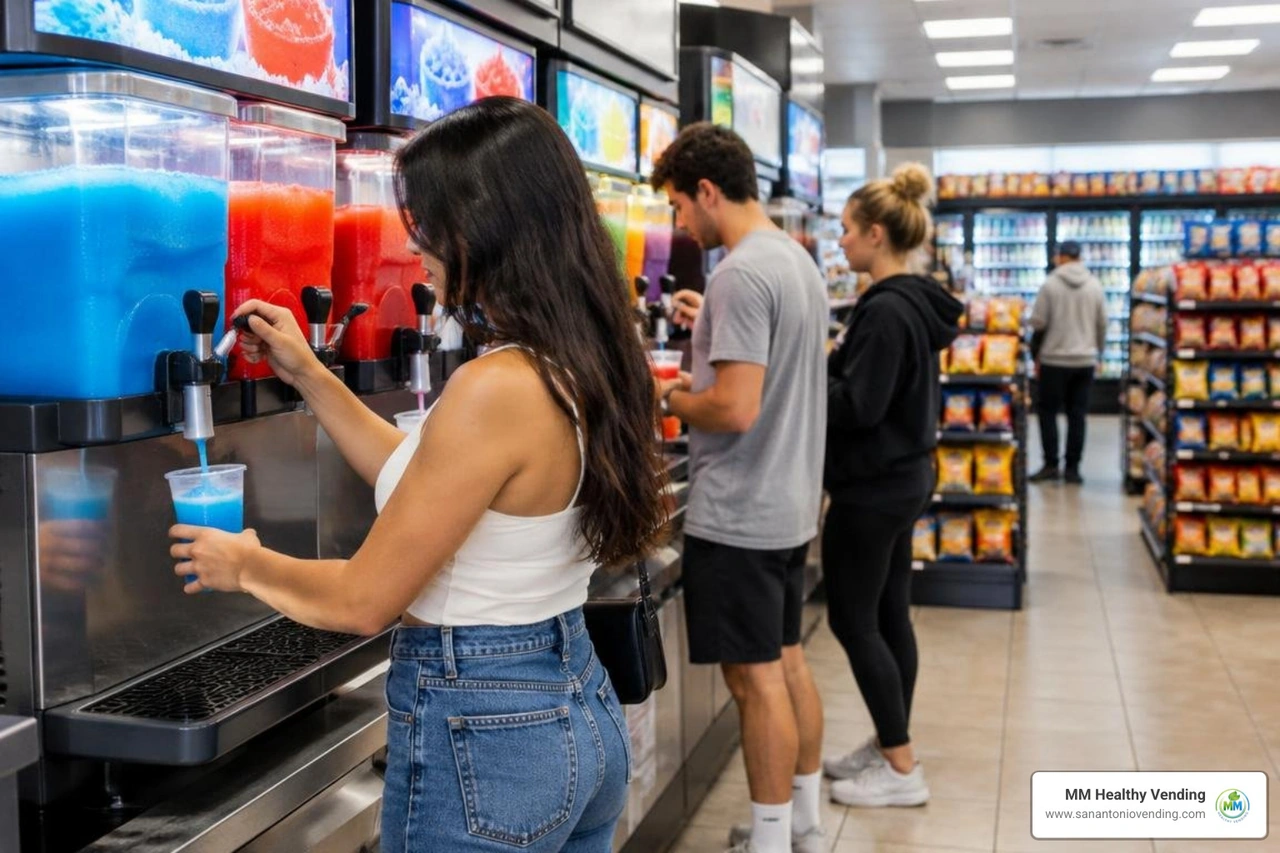
When customers walk up to a beverage counter on a warm afternoon in San Antonio, New Braunfels, or Boerne, they are looking for a drink that stays crisp, icy, and refreshing down to the last drop. In the commercial beverage landscape of October 2026, business operators face a major equipment decision: install a standard open-bowl slushie machine or invest in a high-performance FCB system.
Beyond texture, the commercial economics of carbonated frozen drinks are unmatched. Because carbon dioxide expands the liquid base significantly, businesses yield significantly more finished ounces per gallon of syrup concentrate. Understanding how carbonation, water, and syrup blend under pressure reveals why global brands, cinema chains, and convenience stores rely almost exclusively on FCB technology to drive peak-hour revenue.
How a Frozen Carbonated Beverage Dispenser Works vs. Non-Carbonated Units
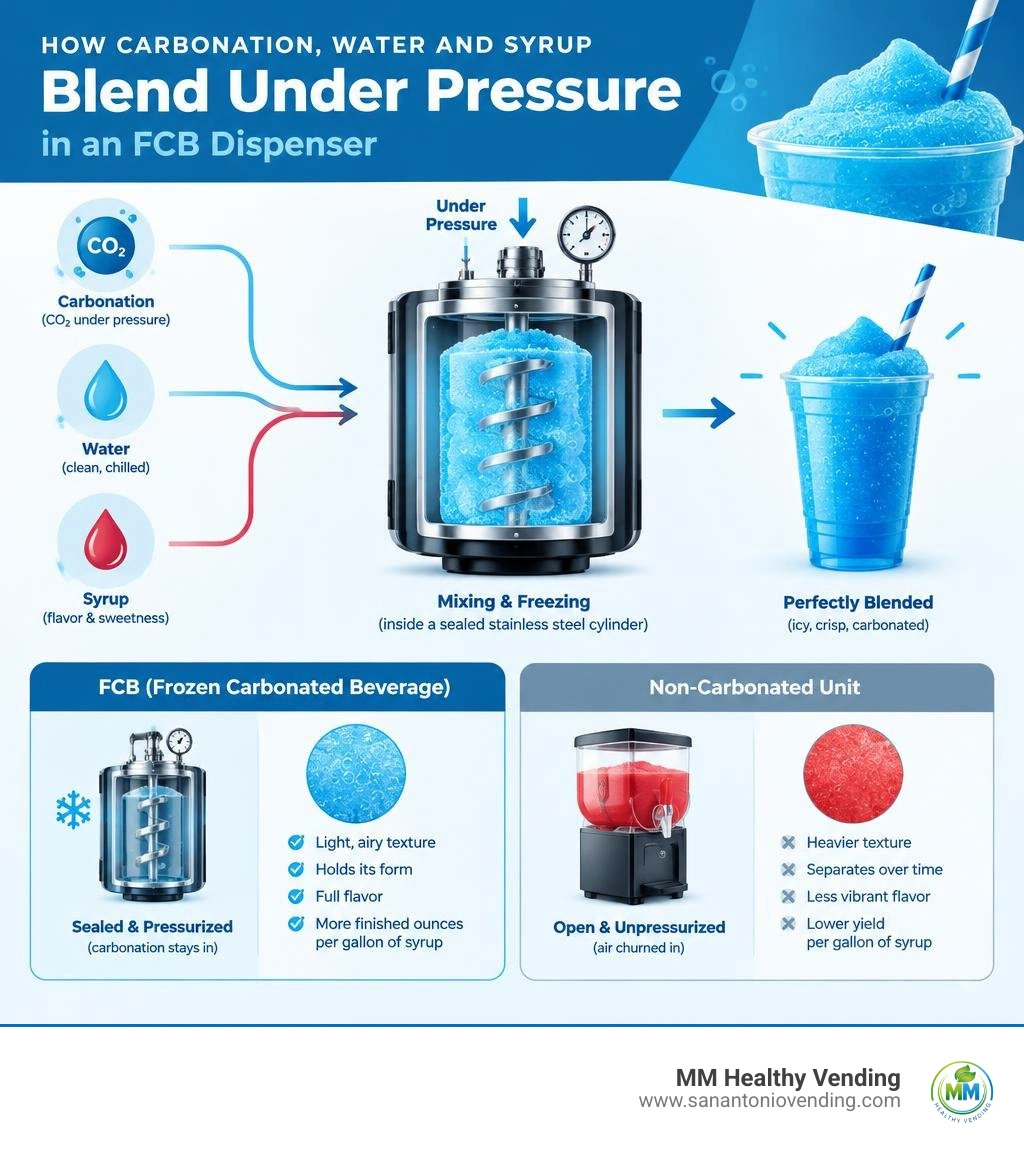
At its simplest, an FCB machine is a precision-engineered closed system. Unlike non-carbonated frozen beverage machines that pour liquid into an open, unpressurized bowl, a commercial FCB unit operates under continuous pressure inside a sealed stainless steel freeze cylinder.
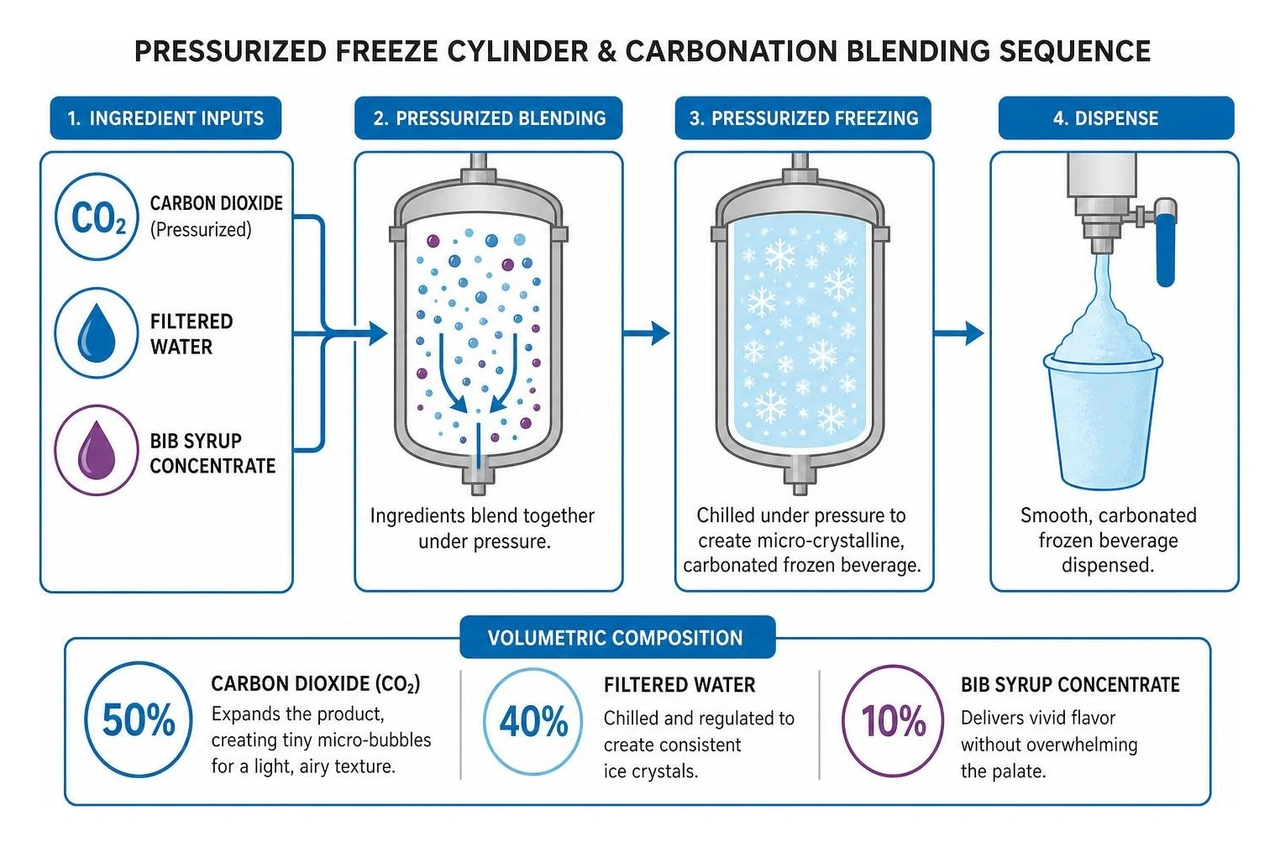
The magic of the FCB drink profile comes from its volumetric composition:
- 50% Carbon Dioxide (CO2): Expands the product, creating tiny micro-bubbles that deliver a velvety, melt-in-the-mouth texture.
- 40% Filtered Water: Chilled and regulated to create consistent ice crystals.
- 10% Bag-in-Box (BIB) Syrup Concentrate: Delivers vivid flavor without overwhelming the palate with dense sugar weight.
Because the barrel is pressurized (typically between 25 and 35 PSI), the CO2 stays fully dissolved in the liquid while it freezes along the cylinder walls. A rotating scraper blade constantly shaves micro-thin sheets of frozen product, ensuring uniform crystal geometry. When pulled through the dispensing valve, the sudden release from pressure allows the gas to expand instantly, yielding a fluffy, effervescent drink that stays suspended rather than sinking into dense liquid slush.
For high-volume operations exploring versatile commercial frozen drink dispenser solutions, this sealed process prevents airborne contamination, eliminates manual batch mixing, and maintains tight quality control from morning to night.
Core Mechanics of a Frozen Carbonated Beverage Dispenser
Commercial units engineered by category leaders like FBD Frozen: Frozen Beverage Dispenser & Beverage Machines incorporate patented sub-systems to maintain peak product integrity:
- Inline Carbonation™: Instead of relying on a separate, bulky carbonator tank sitting under the counter, modern units carbonate water and syrup simultaneously within the internal manifold before injecting it into the freeze chamber.
- OptiFreeze™ Technology: Monitors barrel pressure, torque, and product viscosity in real time. This ensures the dispenser automatically adjusts refrigeration cycles based on customer draw frequency, preventing freeze-up lockouts or watery pours.
- Sealed Expansion Control: Maintains an optimal overrun ratio of 50% to 100%, magnifying product volume and ensuring that every ounce pulled matches brand specifications.
FCB vs. Standard Slushie Equipment Breakdown
To highlight the performance divide, consider how pressurized commercial FCB dispensers stack up against traditional open-hopper slush machines:
| Operational Metric | Frozen Carbonated Beverage Dispenser (FCB) | Standard Open-Hopper Slush Machine |
|---|---|---|
| Chamber Design | Sealed, pressurized stainless steel barrel | Open-air clear plastic hopper |
| Drink Overrun (Air/Gas Expansion) | 50% to 100% via pressurized CO2 | 0% to 15% via passive atmospheric air |
| Syrup-to-Drink Yield | High (10% syrup mix yields 100% finished drink) | Low (requires 16%–20% syrup concentration) |
| Peak Recovery Speed | 3.0 to 4.0 minutes per barrel cycle | 20 to 45 minutes after heavy draw |
| Product Texture Stability | Uniform micro-crystals; holds form for 20+ min | Coarse ice; quickly separates into liquid syrup |
| Sanitation Cycle Frequency | Closed-loop CIP (Clean-in-Place); bi-monthly | Manual breakdown every 3 to 7 days |
| Average Service Life | 8+ years (heavy-duty scroll compressor) | 3 to 5 years (standard reciprocating unit) |
Key Engineering and Performance Advantages of Commercial FCB Equipment

Commercial venues cannot afford downtime when temperatures soar in Seguin, Helotes, or Alamo Heights. FCB units are engineered with industrial components specifically designed for continuous, heavy-duty commercial operation.
Scroll compressor architecture sits at the heart of this reliability. Unlike older reciprocating piston compressors that suffer from heavy mechanical friction, scroll compressors use two interleaved spirals to compress refrigerant smoothly. This design reduces vibration, operates at lower decibel levels, cuts energy draw, and extends the operational lifespan of the refrigeration package to an average of 8+ years.
Furthermore, proprietary engineering like OptiPour™ regulates the dispensing velocity at the nozzle. This eliminates violent splashing and foaming, allowing customers to fill 16 oz, 24 oz, or 32 oz cups rapidly without product overflowing onto the counter. Combined with RapidFreeze™ sub-cooling algorithms, these high-output frozen beverage dispensers eliminate the frustrating "freeze lockouts" that plague standard slush machines during afternoon rushes.
Cooling Configurations: Air-Cooled, Water-Cooled, and Remote-Cooled
Refrigeration packages on high-capacity units—such as the FBD 772 Frozen Beverage Machine - Dual Flavor, High Output—range from 15,000 to 19,000 BTU/hr. Selecting the proper condenser configuration depends entirely on your store layout, ventilation, and plumbing access:
- Air-Cooled Systems:
- Best For: Standard convenience store counters and breakrooms with moderate ambient temperatures.
- How It Works: Internal fans pull room air across the condenser coils and exhaust warm air out the top or sides.
- Considerations: Requires 3 to 6 inches of clear air space around the cabinet to prevent thermal throttling.
- Water-Cooled Systems:
- Best For: Enclosed spaces, hot kitchens, or locations with dedicated recirculating chilled-water loops.
- How It Works: Water circulates through a heat exchanger to reject heat, operating independently of room temperature.
- Performance: Offers faster recovery times (down to 3.5 minutes) while keeping the surrounding counter space cool.
- Remote-Cooled (Remote Condensing) Systems:
- Best For: Movie theaters, high-volume quick-service restaurants (QSRs), and multi-unit entertainment venues.
- How It Works: The compressor and condenser coils are mounted outdoors on the roof or in a back utility room, connected to the dispenser via insulated refrigerant lines.
- Benefits: Eliminates all operational heat and compressor noise from the customer service area, while delivering maximum continuous output.
High-Volume Draw Rates and Rapid Recovery Cycles
When movie theaters break between showtimes or school lets out near Schertz and Southside TX, drink stations face massive surges in demand. A commercial FCB dispenser is engineered specifically to handle continuous line-busting traffic:
- Continuous Draw Capacity: Top-tier 2-barrel and 3-barrel units deliver between 3,600 and 5,760 oz/hr of continuous frozen product.
- Rapid Recovery Speed: After completely draining a 176 oz cylinder during an aggressive rush, the sealed refrigeration system recovers full freeze density in just 3 to 4 minutes.
- Consistency: The automated expansion valve meters incoming water and syrup instantly, chilling the base before it even touches the freeze cylinder wall.
Comparing Leading Multi-Barrel Models and Multi-Flavor Versatility

Choosing the best configuration requires matching barrel capacity and flavor profiles to your daily foot traffic and available counter footprint. Business owners evaluating a reputable commercial frozen drink machine supplier typically choose between multi-barrel dedicated platforms and high-tech single-barrel multi-flavor injection units.
Single-Barrel Multi-Flavor Technology and Customization
For locations with tight counter space that still want to offer an extensive menu, single-barrel multi-flavor machines (such as the FBD 771) represent a breakthrough in beverage merchandising.
Instead of dedicating three or four separate physical freezing barrels to individual flavors, a multi-flavor unit uses a single high-capacity 184 oz base freezing cylinder—typically serving a neutral carbonated base or frozen lemonade. When a customer selects their drink on the integrated 13.3-inch touchscreen, high-precision micro-injection pumps introduce concentrated flavor syrups directly into the stream at the dispense valve.
This single-barrel design allows venues to offer up to 16 distinct flavor combinations (e.g., Cherry-Lime, Blue Raspberry Vanilla, Strawberry Mango) while occupying only 17 inches of counter width and delivering up to 3,600 oz/hr of continuous draw.
Multi-Barrel Workhorses: 2-Flavor, 3-Flavor, and 4-Flavor Systems
For venues serving established core flavors (like classic Cola, Wild Cherry, and Blue Raspberry), dedicated multi-barrel dispensers provide rock-solid throughput across independent freeze chambers.
| Model Series | Barrels / Flavors | Continuous Output (oz/hr) | Dimensions (W × D × H) | Weight (Empty) | Electrical Requirement |
|---|---|---|---|---|---|
| FBD 771 | 1 Base Barrel (Up to 16 Combos) | 3,600 oz/hr | 17.0" × 32.5" × 34.0" | 288 lbs | 230 VAC, 20A (NEMA L6-20R) |
| FBD 772 | 2 Dedicated Barrels (2 Flavors) | 4,500 – 5,020 oz/hr | 20.3" × 32.5" × 34.0" | 298 lbs | 230 VAC, 20A (NEMA L6-20R) |
| FBD 773 | 3 Dedicated Barrels (3 Flavors) | 5,580 – 5,760 oz/hr | 26.0" × 32.5" × 34.0" | 356 lbs | 230 VAC, 30A (NEMA L6-30R) |
| FBD 774 | 4 Dedicated Barrels (4 Flavors) | 6,200+ oz/hr | 34.0" × 32.5" × 34.0" | 425 lbs | 230 VAC, 30A (NEMA L6-30R) |
Business ROI, Operational Costs, and Venue Fit
Whether you operate a family entertainment center, a corporate breakroom lounge, a high-volume QSR, or are evaluating specialized commercial margarita beverage dispensers for hospitality settings, FCB programs represent one of the most profitable footprints in the entire food and beverage industry.
Choosing the Right Frozen Carbonated Beverage Dispenser for Your Business
Before delivery and installation, ensure your facility meets standard commercial utility requirements:
- Electrical Infrastructure: Commercial FCB units require a dedicated 230 VAC single-phase circuit on either a 20-amp (NEMA L6-20R) or 30-amp (NEMA L6-30R) twist-lock receptacle.
- Water Supply & Filtration: A dedicated 3/8-inch potable water line delivering a minimum of 30 to 50 PSI dynamic pressure. High-grade carbon block water filtration is essential to remove chloramines, sediment, and scale-forming minerals.
- CO2 System: Access to high-pressure beverage-grade CO2 cylinders or an existing bulk liquid CO2 tank, regulated to 70–80 PSI incoming manifold pressure.
- Syrup Storage (BIB Rack): Dedicated space in a back storage room or under-counter cabinet for bag-in-box syrup racks and pneumatic syrup pumps.
Profit Margins, Maintenance, and Return on Investment
The economic power of an FCB program lies in its expansion ratio:
- Lower Cost per Ounce: Because 50% of the finished cup volume consists of expanded CO2 gas and 40% is purified water, your consumable cost is heavily concentrated in just the 10% syrup component.
- Massive Gross Margins: While standard fountain sodas generate healthy 70% to 75% gross margins, an optimized FCB program routinely exceeds 80% to 85% gross margins.
- Rapid Payback Period: A convenience store selling seventy 20-oz frozen carbonated drinks per day at $2.49 each will generate roughly $5,200 in monthly gross revenue against a cost of goods (syrup, CO2, cup, lid, straw) under $800. This delivers a complete machine payback in under 12 to 18 months.
- Warranty Protection: Industry leaders provide 5-year sealed refrigeration system warranties and 1-year parts coverage, minimizing total cost of ownership.
Frequently Asked Questions About FCB Equipment
What is the ideal ratio of CO2, water, and syrup in a frozen carbonated beverage dispenser?
The standard volumetric formula for an authentic frozen carbonated beverage is approximately 50% dissolved CO2 gas, 40% filtered water, and 10% syrup concentrate. This creates a balanced brix level, prevents the product from freezing solid into a block of ice, and yields the fluffy, light texture associated with commercial frozen drinks.
What electrical and utility connections are required for commercial FCB dispensers?
Commercial FCB dispensers require a dedicated 230 VAC single-phase circuit (20-amp or 30-amp with NEMA L6-20R or L6-30R twist-lock plugs), a 3/8-inch pressurized potable water supply line with pre-filtration, and a high-purity CO2 line regulated between 70 and 80 PSI.
How quickly do high-capacity FCB machines recover during peak hours?
Commercial FCB units equipped with 15,000–19,000 BTU/hr refrigeration packages and scroll compressors recover freeze density in 3.5 to 4 minutes after a full barrel draw. This allows operators to serve continuous lines without product liquefying.
Conclusion
Upgrading from a standard slush machine to a commercial frozen carbonated beverage dispenser transforms a sluggish drink station into a high-capacity, high-margin profit center. With rapid recovery cycles, superior drink overrun, and durable scroll compressor engineering, FCB systems ensure your drinks stay perfectly carbonated and smooth even during the hottest Texas afternoon rushes.
At MM Healthy Vending, we help businesses across San Antonio, New Braunfels, Boerne, Schertz, Seguin, Helotes, Alamo Heights, and Southside TX modernize their refreshment programs. Whether you need fully managed breakroom vending, micro-markets, or high-capacity beverage setups, we provide zero-cost, fully managed solutions backed by responsive 2-hour local support. Discover how our custom commercial beverage and vending services can elevate your workplace refreshment experience today.
You might also like...
More articles like the one you've read to keep you up-to-date on all things vending in San Antonio

Why San Antonio businesses choose us
Premium service, local expertise, cutting-edge technology
AI-powered smart coolers
Advanced computer vision technology for seamless, cashless transactions. Just grab what you need and go.
cashless
24/7 service
Round-the-clock support with an average 2-hour response time for any issues.
Local & trusted
Family-owned business proudly serving San Antonio since 2024
Ready to upgrade your breakroom?
Join hundreds of San Antonio businesses enjoying free, premium vending soutions