
Keep the Margaritas Pouring Fast with These Top Drink Dispensers
Find the perfect margarita beverage dispenser for fast, high-volume frozen drinks at home or in your cantina.
Main Types of Margarita Beverage Dispenser Equipment
Finding the right dispensing setup requires looking at how your drinks will be stored, chilled, and served. Across hospitality venues, restaurants, catering setups, and backyard patios, drink dispensers generally fall into four distinct categories:
- Commercial Slush and Continuous-Freeze Dispensers: These heavy-duty units use refrigerated freezing cylinders, heavy augers, and high-BTU compressors to freeze liquid mixes rapidly. They are designed to deliver continuous pours during peak rush hours.
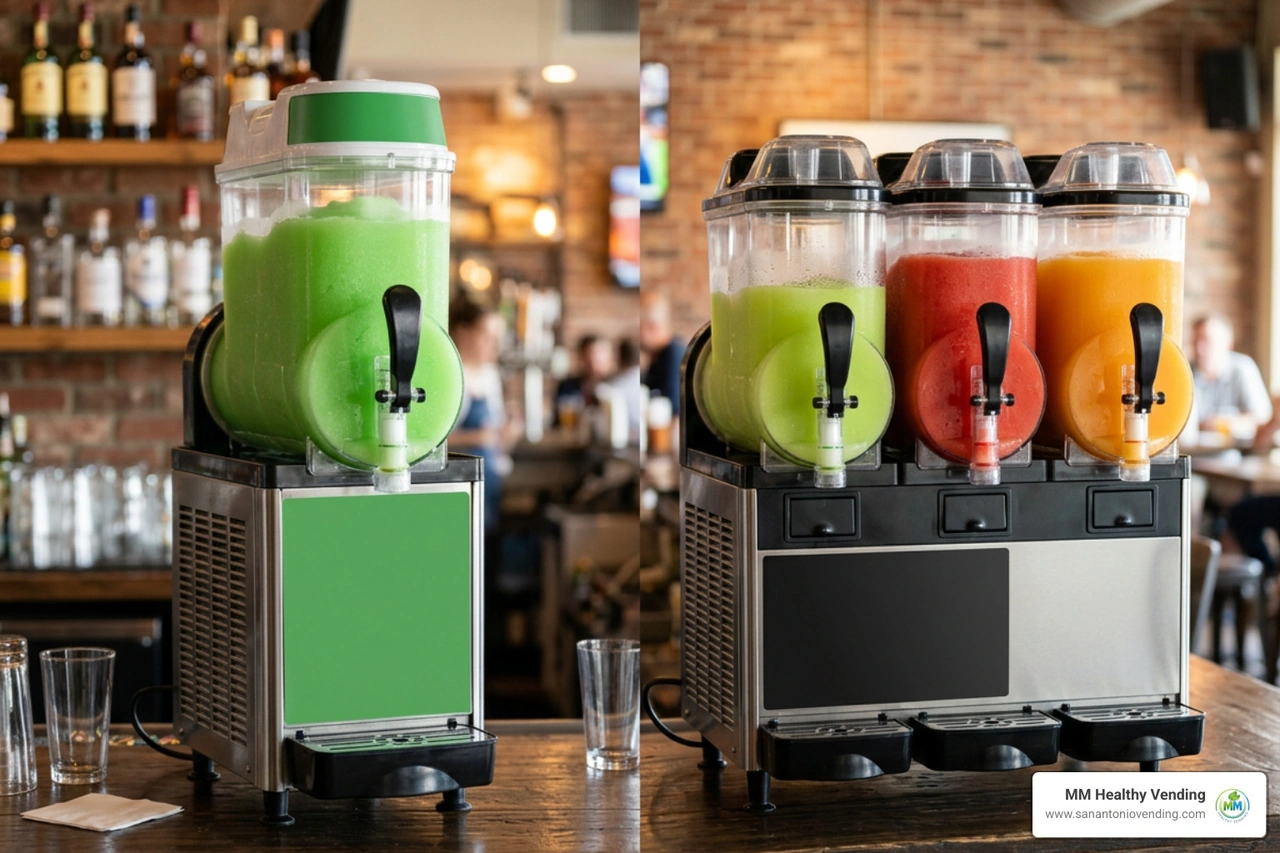
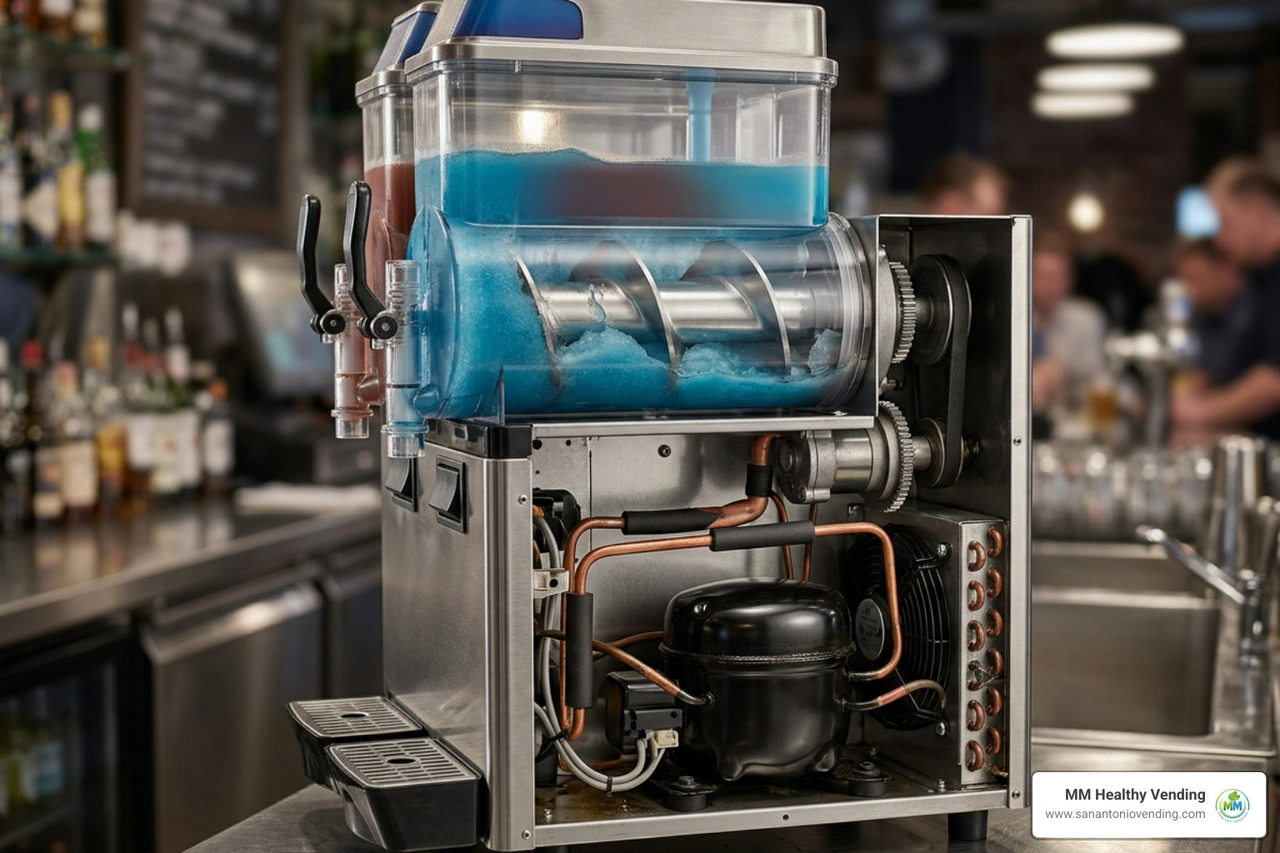
- Refrigerated Clear-Bowl Granita Machines: Featuring transparent polycarbonate hoppers and rotating spiral augers, these machines showcase the vibrant colors of spinning frozen margaritas, daiquiris, or slushies to drive impulse orders.
- Pressurized Draft Cocktail Systems: These non-electric, stainless steel mini-keg setups use regulated gas cylinders (CO2 or nitrogen) to push pre-batched liquid margaritas through standard draft faucets on tap.
- Insulated Ambient and Ice-Core Dispensers: Traditional glass jars or insulated thermal dispensers hold large batches over ice for simple, uncarbonated on-the-rocks service.
The history of frozen drinks runs deep in our home state, where automated frozen cocktail equipment permanently changed how cantinas and restaurants handle bar service (you can explore these rich Texas cocktail traditions to see how the frozen drink revolution began). Whether your priority is crystal-clear visual merchandising or relentless high-volume throughput, choosing between single-tank and multi-tank configurations dictates your menu flexibility.
Single-tank dispensers keep costs and counter footprints low, making them great for operations dedicated to a single signature cocktail. Multi-tank units (offering two, three, or four separate bowls) allow businesses to run multiple flavors side-by-side—such as a classic lime margarita alongside strawberry daiquiris, piña coladas, or non-alcoholic lemonades—ensuring you never have to pause service when refilling a single flavor.
Choosing a Commercial Margarita Beverage Dispenser for High-Volume Service
For high-traffic bars, event centers, and busy restaurants, continuous-freeze commercial machines are essential. High-production units—such as the Spaceman dual-hopper margarita dispenser specifications—utilize powerful 4,000-BTU compressors running R404A refrigerant alongside dual 4-quart freezing cylinders and dual 8.5-quart mix hoppers. This hardware setup delivers up to 25 quarts per hour, translating to roughly 192 continuous servings every 60 minutes.
High-capacity systems often feature closed Bag-in-Box (BIB) syrup feeds and automated continuous pumps. Units like the FBD 772 FC pour up to 4,500 oz/hour across two flavors, while larger three- and four-flavor dispensers (FBD 773 FC and 774 FC) hit output rates of up to 5,160 oz/hour. These sealed systems eliminate manual batch mixing, saving your team 1 to 2 hours of daily prep and cleaning while maintaining strict hygiene standards.
Selecting a Residential Margarita Beverage Dispenser for Home Parties
If you are hosting backyard celebrations, family reunions, or weekend gatherings, commercial continuous-pour giants are rarely practical. Compact residential frozen drink makers—like the Margarita Girl Single-Bowl Mini—feature a 1.6-gallon hopper bowl that produces around 25 cups of slush per batch. These units plug into any standard 120-volt household outlet, draw minimal power with a 1/5-HP compressor, and weigh around 40 pounds for easy tabletop transport.
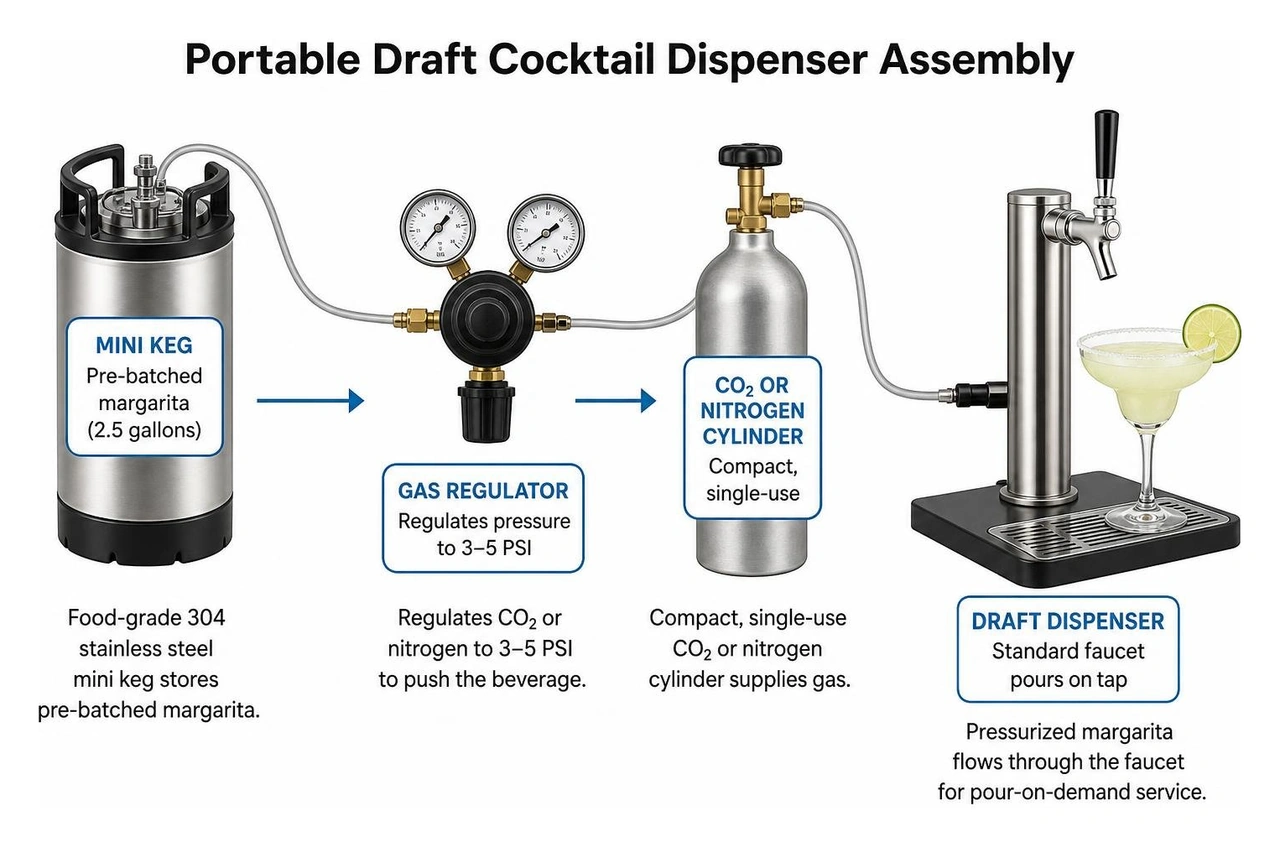
For tailgates, park gatherings, or outdoor patio events where electrical outlets are unavailable, a draft cocktail system like the QuikTap portable draft cocktail system setup offers an outstanding alternative. Built from food-grade 304 stainless steel, this 2.5-gallon mini-keg system runs on compact, single-use CO2 or nitrogen cylinders regulated to 3–5 PSI. It pours pre-batched craft margaritas on tap without requiring any power cords or noisy motors.
Key Buying Considerations: Capacity, Speed, and Freezing Mechanics
Selecting the ideal drink dispenser involves balancing several technical elements: hopper volume, compressor cooling speed, electrical draw, and physical counter clearance.
To keep your equipment running smoothly and avoid watery drinks, keep these core operating variables in mind:
- Hopper Capacity and Batch Yield: Standard countertop commercial bowls range from 15 liters (3.96 gallons) up to multi-bowl configurations holding over 45 liters total. A single 15L tank yields between 40 to 60 large cups or roughly 77 individual 7-ounce servings.
- Compressor Power and Freeze-Down Time: Entry-level 500W to 650W single-tank units typically freeze an initial room-temperature batch in 20 to 50 minutes. Multi-tank high-capacity systems drawing 1,100W to 1,600W maintain freezing speeds even when new room-temperature mix is added during service.
- Sugar (Brix) Content Calibration: Frozen drink dispensers require a balanced sugar concentration between 12% and 15% (a 1:6 to 1:7.5 sugar-to-water ratio). Sugar acts as a natural anti-freeze; without sufficient sugar, the mix freezes into solid ice chunks that can lock and damage the rotating auger.
- Alcohol Content Thresholds: Alcohol significantly depresses the freezing point of liquids. Keep the alcohol by volume (ABV) in your machine's hopper below 13%. To freeze alcoholic cocktail batches properly, dial your dispenser's internal temperature down to between 5°F and 21.2°F (-15°C to -6°C), compared to standard non-alcoholic slush settings of 26.6°F to 30.2°F (-3°C to -1°C).
- Air-Cooled Ventilation and Ambient Heat: Air-cooled compressors require at least 6 inches of open clearance on all ventilation sides to exhaust heat. Operating an air-cooled dispenser in direct outdoor Texas summer heat above 80°F to 90°F will substantially slow down freeze times and cause the product to melt.
| Equipment Type | Typical Capacity | Power Requirement | Freeze Time per Batch | Best Use Case |
|---|---|---|---|---|
| Commercial Continuous-Freeze | Dual 8.5-qt hoppers + 4-qt cylinders | 115V / 15A or 208-230V | 10–20 min recovery (192 servings/hr) | High-volume bars, cantinas, busy restaurants |
| Clear-Bowl Granita/Slush Machine | 15L to 45L (1 to 3 tanks) | 110V / 500W–1300W | 20–50 minutes initial freeze | Cafes, convenience stores, wedding venues |
| Residential Frozen Drink Maker | 1.6 to 3.2 gallons | 120V household / 1/5-HP | ~90 to 120 minutes | Home parties, small office celebrations, tailgates |
| Pressurized Draft Mini-Keg | 2.5 gallons (2-gal batch) | Non-electric (CO2 / N2 gas) | Pre-chilled liquid (No freezing) | Remote outdoor catering, craft cocktail pop-ups |
Margarita Machines vs. Traditional Blenders: Efficiency and Profitability
Relying on standard countertop blenders during a high-volume rush creates immediate operational bottlenecks. Bartenders must measure ice, add liquor, pour mixes, secure lids, pulse, blend, pour, and rinse each pitcher between orders. When several tables order frozen drinks at once, service times stall.
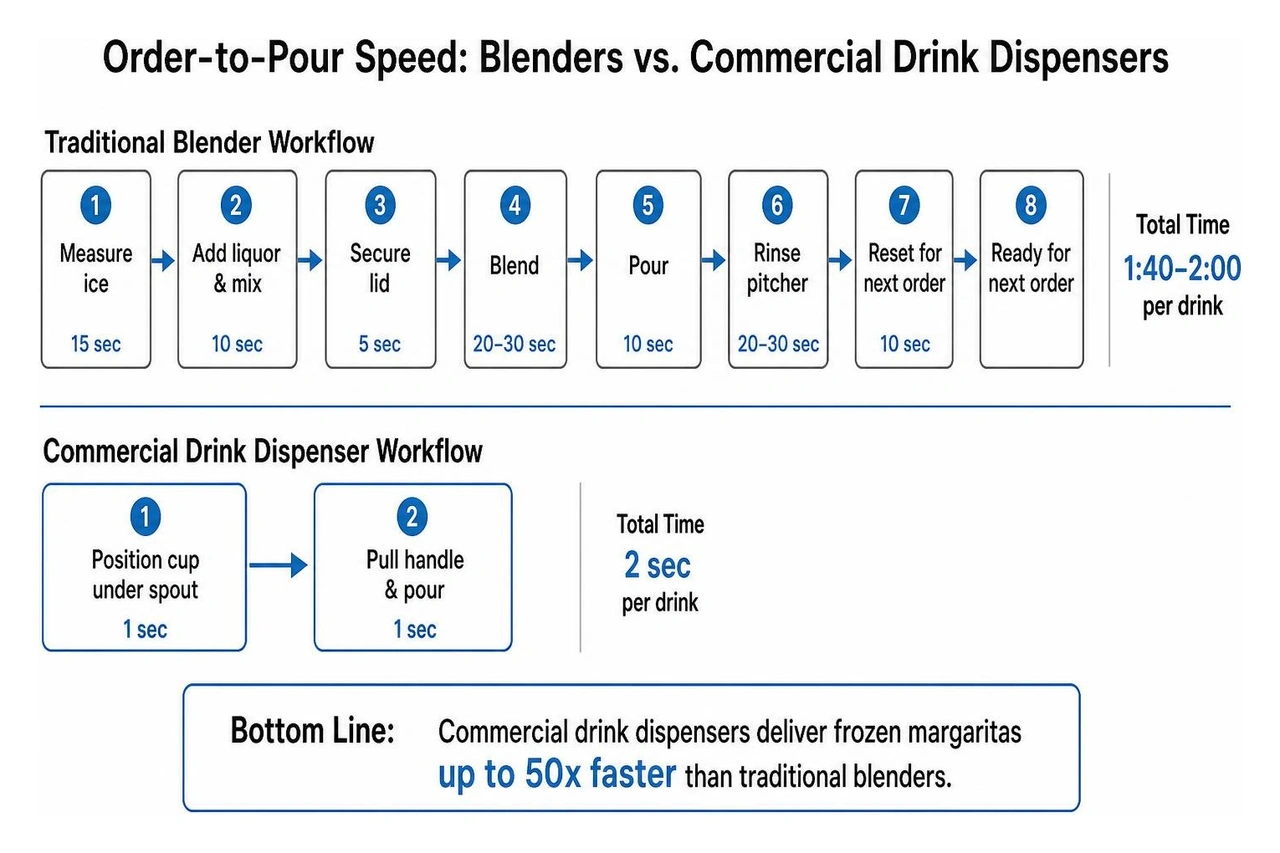
Dedicated dispensers streamline this process into a simple, two-second pour-and-serve motion. This efficiency pays off across several key areas:
- Eliminating Blender Rinses and Wait Times: Pre-batching eliminates measuring mistakes and noisy blending cycles, letting your staff focus entirely on customer service.
- Consistent Micro-Crystal Texture: Machine augers constantly churn the beverage around a refrigerated cylinder, preventing liquid separation and ice clumping for a smooth, uniform texture every time.
- Fast Return on Investment (ROI): Premium frozen cocktails carry high profit margins. A commercial frozen drink dispenser that speeds up order delivery can pay for itself within 3 to 6 months through increased volume and reduced labor costs.
- Menu Versatility: Modern dispensers handle everything from margaritas and daiquiris to frozen sangrias, frosé, frozen coffee frappes, and non-alcoholic slushies.
This focus on rapid, high-quality drink execution mirrors modern cocktail programs across Texas, including top beverage trend coverage in local Alamo Heights venues, where consistent texture and fast service keep guest satisfaction high year-round.
Maintenance, Sanitation, and Daily Cleaning Routines
Proper cleaning and preventative maintenance protect your investment, maintain health department compliance, and prevent unexpected mechanical downtime.
Keep your dispensing equipment in peak condition with these core maintenance practices:
- Daily Automatic Flush Cycles: Empty any leftover mix at the end of the day, fill the hopper with lukewarm water, and run the machine’s automated wash cycle to clear residual sugars from the lines and auger channel.
- Overnight Preserve / Night Mode: If your machine includes an overnight refrigeration mode, it can hold mix safely at 37.4°F to 39.2°F (3°C to 4°C) until the next morning. However, to maintain fresh taste and food safety, fully empty and sanitize hoppers every 24 to 48 hours.
- Pulp and Seed Filtration: When using fresh lime juice or purees in draft or granita dispensers, thoroughly strain out all fruit pulp and seeds before filling. Stray solids will clog draft faucets, check valves, and dispensing seals.
- Gasket Inspection and Food-Grade Lubrication: Disassemble the dispensing tap, auger seals, and rear hopper O-rings weekly. Wash them in warm sanitizing solution, inspect for cracks or wear, and apply food-grade silicone lubricant before reassembly to prevent leaks.
- Condenser Filter Cleaning: Brush or vacuum the air-cooled condenser fins monthly. Dust accumulation restricts airflow, forcing the compressor to work harder, extending freeze times, and shortening the machine's operational lifespan.
With routine maintenance and regular seal replacements, quality commercial beverage dispensers reliably provide a service life of 7 years or more. To discover more ways to elevate your workplace dining and hospitality setup, explore our workplace and refreshment blogs.
Frequently Asked Questions About Margarita Dispensers
How long does a margarita dispenser take to freeze a batch?
Freeze times vary based on compressor strength, ambient air temperature, and the recipe's alcohol content. High-efficiency commercial machines equipped with copper compressors and refrigerated cylinders typically freeze a full 15-liter batch in 20 to 50 minutes. Compact residential or light-commercial countertop units generally take 90 minutes to 2 hours. Adding warm alcohol directly to the mix lowers the liquid's freezing point; for faster results, always chill your base mix in a refrigerator before adding it to the dispenser hopper.
Why is my frozen drink machine not turning into slush?
A machine that runs without freezing usually has a mix chemistry issue or improper ventilation:
- Insufficient Sugar Content: Slush machines need a sugar concentration of 12% to 15% (Brix). If you are using sugar-free mixers or diluting your batch with too much water, ice crystals cannot form a stable slush.
- Excessive Alcohol Content: If the mix exceeds 13% ABV, the alcohol will keep the liquid from freezing solid at standard machine temperatures.
- Poor Air Clearance: If the machine’s side and rear intake vents are placed flush against a wall, the compressor will overheat, tripping thermal cutoffs and halting the refrigeration cycle.
Can you run non-alcoholic slushies and margaritas at the same time?
Yes, provided you choose a multi-tank dispenser with independent controls for each bowl. Because alcohol depresses the freezing point, alcoholic margaritas require a colder operating temperature (5°F to 21.2°F) than non-alcoholic slushies (26.6°F to 30.2°F). Dual-tank and triple-tank units feature separate thermostats and auger switches for each hopper, allowing you to run a frozen margarita on one side and a non-alcoholic fruit slush, iced coffee, or granita on the other.
Conclusion
Upgrading to a dedicated margarita dispenser eliminates bar bottlenecks, guarantees consistent cocktail quality, and helps your team serve delicious drinks at peak speed. By carefully matching your expected hourly volume, electrical setup, and recipe requirements to the right commercial or residential machine, you can turn any bar, patio, or event space into an efficient, high-margin beverage station.
At MM Healthy Vending, we help businesses across San Antonio, New Braunfels, Boerne, Schertz, Seguin, Helotes, and Alamo Heights elevate their workplace amenities with modern breakroom solutions. From free vending machines and self-checkout micro markets to smart AI coolers, we deliver zero-cost, fully managed beverage and snack programs backed by 2-hour local service. Contact our team today to discover how our full-service commercial refreshment services can transform your workplace!
You might also like...
More articles like the one you've read to keep you up-to-date on all things vending in San Antonio
Why San Antonio businesses choose us
Premium service, local expertise, cutting-edge technology
AI-powered smart coolers
Advanced computer vision technology for seamless, cashless transactions. Just grab what you need and go.
cashless
24/7 service
Round-the-clock support with an average 2-hour response time for any issues.
Local & trusted
Family-owned business proudly serving San Antonio since 2024
Ready to upgrade your breakroom?
Join hundreds of San Antonio businesses enjoying free, premium vending soutions