
Top Commercial Frozen Beverage Dispensers That Keep Drinks Flowing
Find the best frozen drink dispenser for high-volume venues, with specs, recovery times, and installation tips to maximize profits.
Choose a Frozen Drink Dispenser Built for Your Service Volume
The best commercial frozen drink dispenser depends on what you serve, how many drinks you expect to pour at busy times, and the space and power available at your location. High-volume venues often need multi-barrel, fast-recovery equipment, while offices, cafes, and smaller facilities may do better with a compact countertop granita or slush machine.
Look for these basics first:
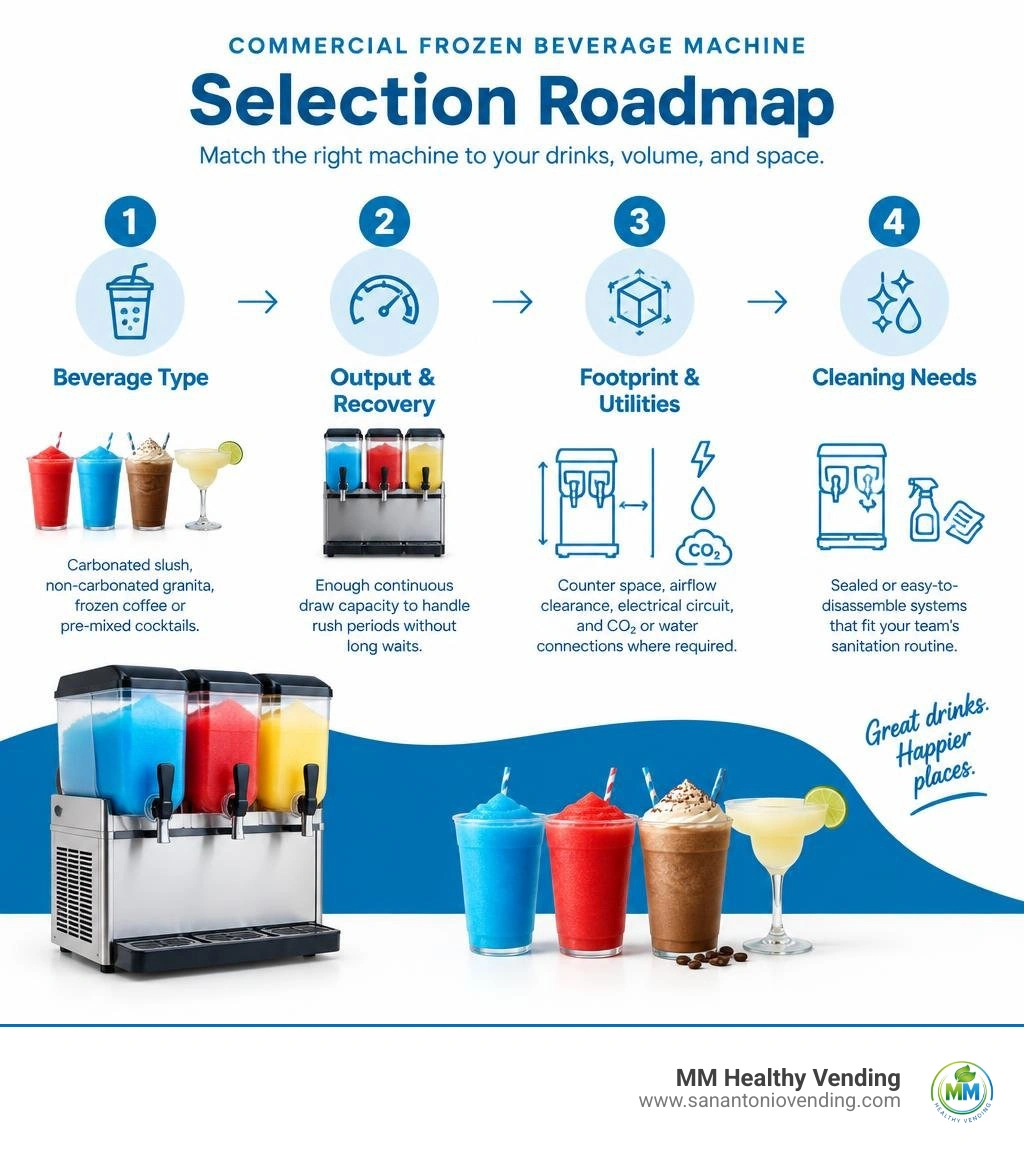
- Beverage type: carbonated slush, non-carbonated granita, frozen coffee, or pre-mixed cocktails
- Output and recovery: enough continuous draw capacity to handle rush periods without long waits
- Footprint and utilities: counter space, airflow clearance, electrical circuit, and CO2 or water connections where required
- Cleaning needs: sealed or easy-to-disassemble systems that fit your team's sanitation routine
Frozen drinks can be a strong add-on because they are fast to serve, visually appealing, and easy to portion. The right machine helps keep quality steady while reducing manual prep during the busiest parts of the day.
I am Manuel Mojica, a San Antonio-based automated retail operator with nationwide equipment deployments and years of experience building vending, smart cooler, and micro-market programs. I evaluate frozen drink dispenser options through the same practical lens: reliable uptime, simple service, efficient use of space, and a better experience for the people using the location.
Frozen drink dispenser further reading:
Commercial Frozen Drink Dispenser Types and Technologies
Selecting the right commercial setup requires matching your drink menu to the mechanical architecture of the machine. Today's commercial units range from sealed, pressurized carbonation units to open-hopper visual granita bowls.
| Category | Primary Applications | Typical Product Yield / Ratio | Key Technology |
|---|---|---|---|
| Frozen Carbonated (FCB) | Slushies, carbonated sodas | 50% CO₂, 40% water, 10% syrup | Inline carbonation, pressurized expansion |
| Frozen Uncarbonated (FUB) | Lemonades, juices, iced coffee | 4.5:1 water-to-concentrate ratio | Open visual bowl, magnetic drive auger |
| Alcoholic Pre-Mix | Margaritas, daiquiris, frosé | 1 part liquor, 4 parts mix/water | OptiFreeze™ Brix tracking, low-temp barrel |
| Multi-Flavor Injection | High-variety cocktail bars | Up to 16 drink combinations | Multi-line injection, OptiPour™ dosing |
Frozen Carbonated and Uncarbonated Systems
Frozen carbonated beverage (FCB) dispensers utilize closed, pressurized barrel architectures that infuse pressurized carbon dioxide directly into the product stream. These systems operate on a strict mixture formula: roughly 50% CO₂, 40% filtered water, and 10% bag-in-box (BIB) syrup concentrate. By incorporating gas under pressure, FCB units achieve significant overrun (expansion), transforming syrup into a light, airy slush that generates exceptional profit margins.
Advanced commercial units integrate technologies like Inline Carbonation™ and RapidFreeze™ to flash-freeze the mixture within a sealed chamber. This eliminates atmospheric exposure, increases hygiene, and bypasses the need for daily teardowns.
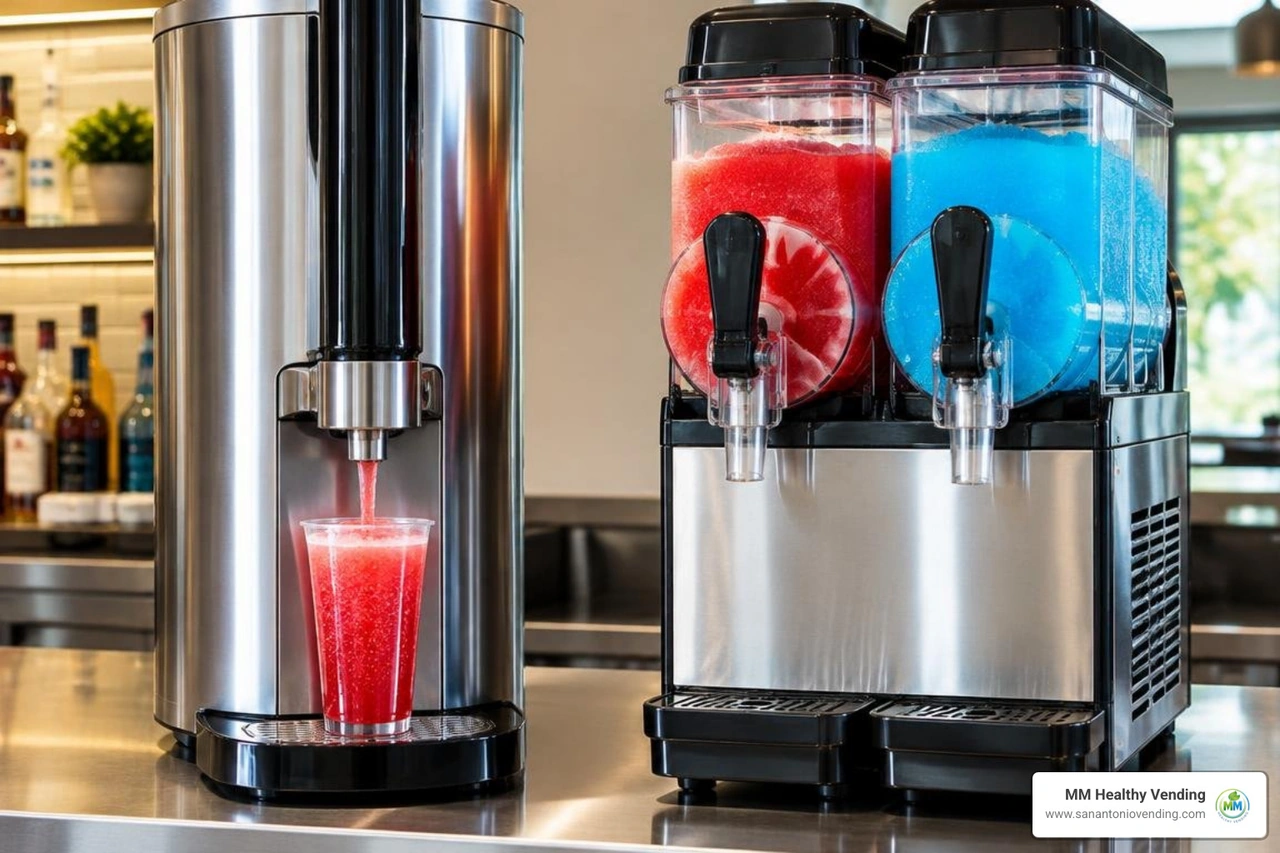
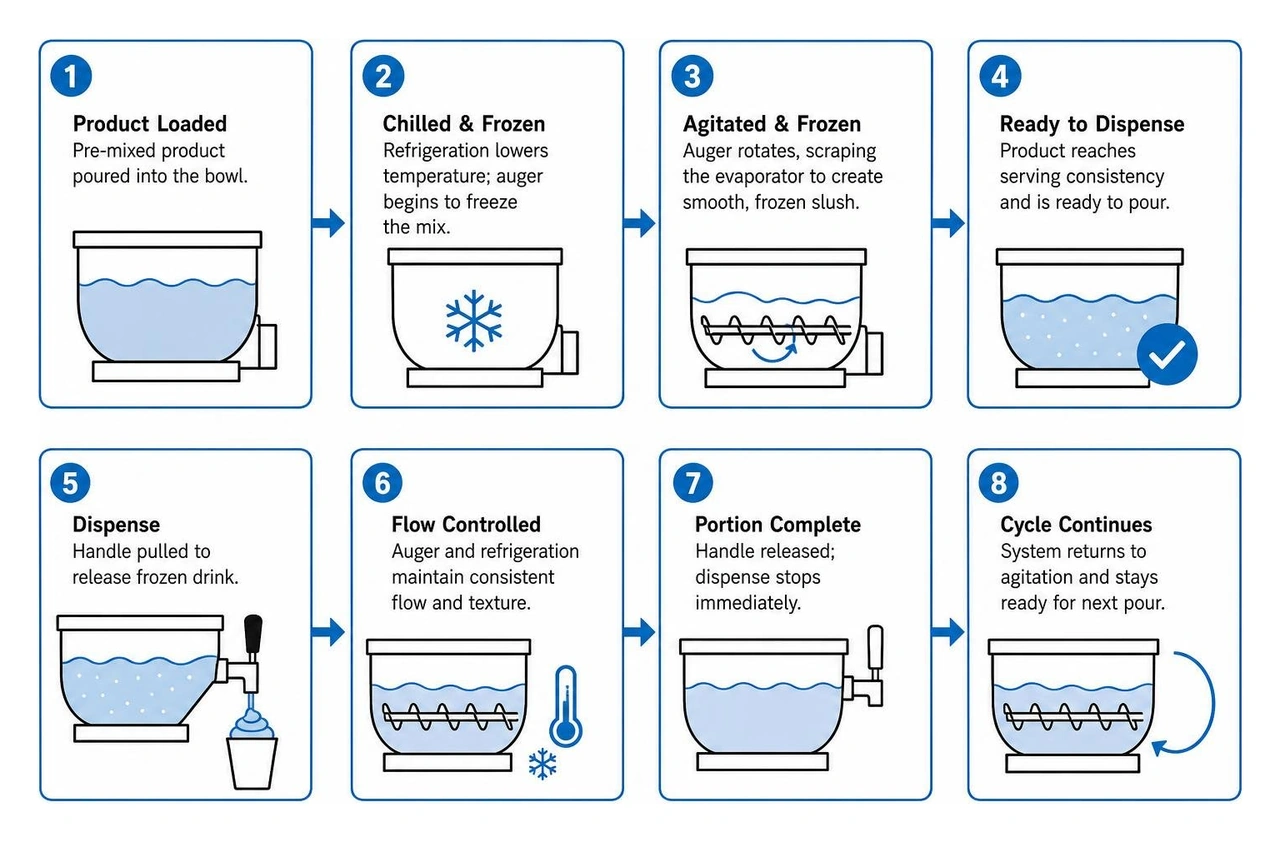
In contrast, uncarbonated granita dispensers utilize transparent, gravity-fed product bowls. A rotating horizontal or vertical auger sweeps continuously across a refrigerated evaporator drum. While these visual systems do not expand product through gas injection, their vibrant, churning display drives impulse sales in convenience hubs and casual dining spots across Alamo Heights and Southside San Antonio.
Alcoholic Pre-Mix and Multi-Flavor Platforms
Freezing alcoholic beverages introduces unique chemical challenges because ethanol lowers the freezing point of water. Dedicated cocktail systems—such as a specialized margarita beverage dispenser—are engineered with high-torque gear motors and low-temperature refrigeration systems capable of handling pre-mixed batches of tequila, rum, or wine bases.
Multi-flavor platforms expand menu variety without consuming excessive counter space. Rather than dedicating an entire freezing barrel to a single recipe, multi-flavor injection systems use neutral frozen bases and inject concentrated flavor syrups directly at the dispense nozzle via OptiPour™ technology. This allows a single dual-barrel footprint to pour up to 16 distinct cocktail combinations, ranging from classic lime margaritas to strawberry daiquiris, mango frosés, and creamy piña coladas.
Top Commercial Dispensers for High-Volume Venues
Commercial high-traffic venues require industrial-grade refrigeration capacity, heavy-duty scroll compressors, and rapid recovery rates. Premium commercial units boast an expected lifespan of 7+ years under continuous operation, as demonstrated in benchmark commercial platforms like the FBD 772 FC Specifications, delivering consistent drink textures even during peak lunch or evening rushes.
High-Capacity Multi-Barrel Frozen Drink Dispenser Units
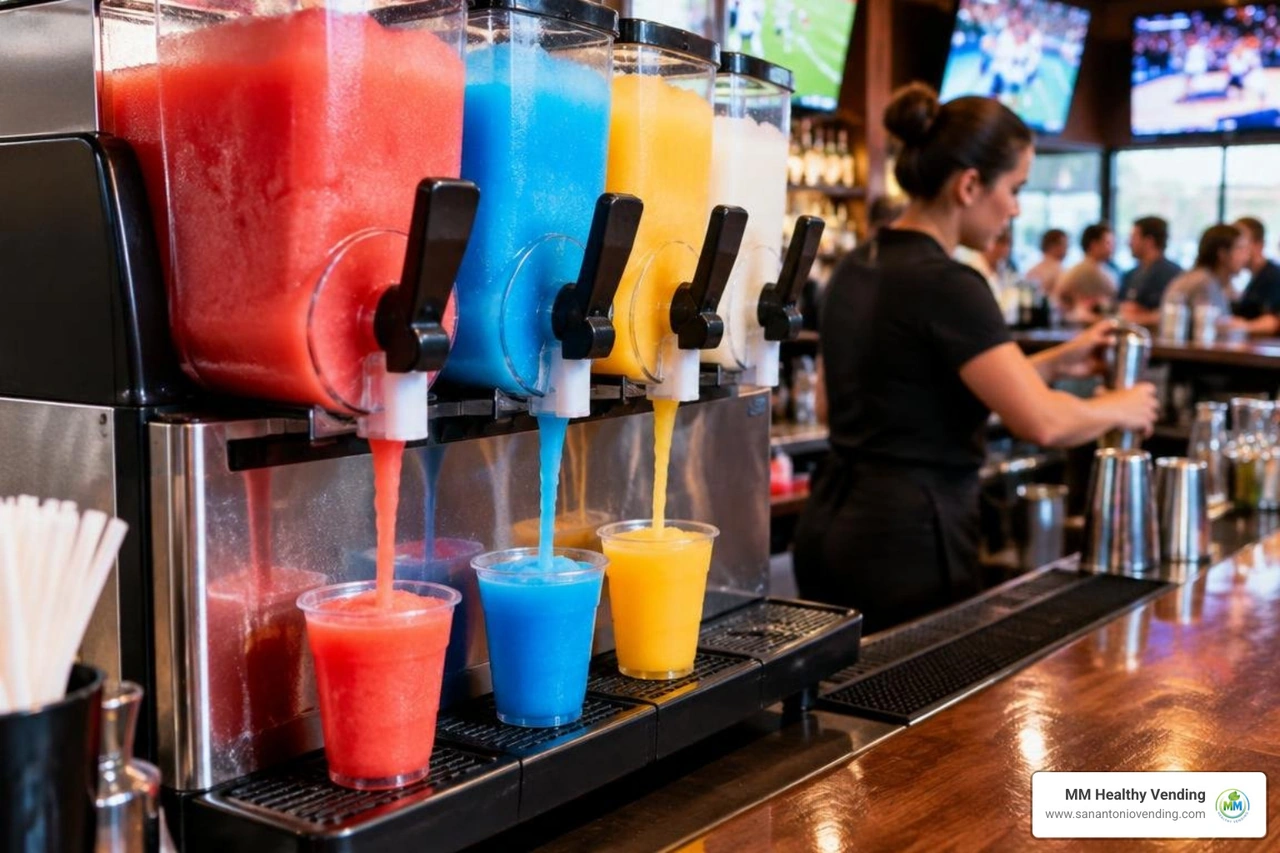
For stadiums, cinema lobbies, and high-volume entertainment venues, multi-barrel systems are the workhorses of the foodservice line. Leading 4-barrel commercial dispensers provide continuous draw rates reaching 4,500 to 5,160 oz/hr.
Equipped with 176 oz freezing cylinders and heavy-duty 19,000 BTU/hr cooling systems, these machines maintain a rapid 4-minute recovery cycle. When a series of 16-ounce cups are pulled back-to-back, the machine replenishes and re-freezes the core mixture within minutes, preventing thin or watery pours during high-volume periods.
Compact Countertop Frozen Drink Dispenser Solutions
When square footage is tight, businesses rely on compact, self-contained countertop dispensers. Modern engineering packs high-output freezing cylinders into units requiring as little as 18 to 26 inches of counter width.
Popular single-bowl countertop models, such as the Spaceman 6450-C, utilize a 12.7-quart hopper (3.175-gallon capacity) to deliver up to 110 ten-ounce servings per hour on standard 115V circuits. For higher velocity needs, dual-cylinder countertop units feature a 7.3-quart cylinder and a 21.2-quart refrigerated hopper, churning out up to 240 drinks per hour. These countertop setups provide restaurants, breakrooms, and micro-markets with commercial-grade slush capabilities without demanding dedicated floor remodels.
Key Technical Specifications and Selection Criteria
Investing in a commercial frozen drink setup requires careful evaluation of technical specs to keep the total cost of ownership (TCO) low and long-term profit margins high.
Capacity, Recovery Times, and Draw Rates
A commercial machine's capacity is split between two metrics: mix hopper volume and freezing barrel volume.
- Freezing Barrel: The active chamber where the liquid is chilled into slush.
- Mix Hopper: The storage reservoir that pre-chills liquid before feeding it into the barrel.
In high-volume settings, a machine with a 4-minute recovery time and a 14,000 BTU/hr compressor (such as the Stoelting SO218) prevents service bottlenecks. Magnetic drive systems further enhance reliability by magnetically coupling the motor to the internal auger. This eliminates mechanical drive shaft seals that can wear down, leak sticky syrup into internal motor housings, or generate loud operational noise.
Brix Ratios, Alcohol Limits, and Freezing Dynamics
To freeze correctly without locking up the auger or dispensing pure liquid, every recipe must balance sugar content and alcohol volume.
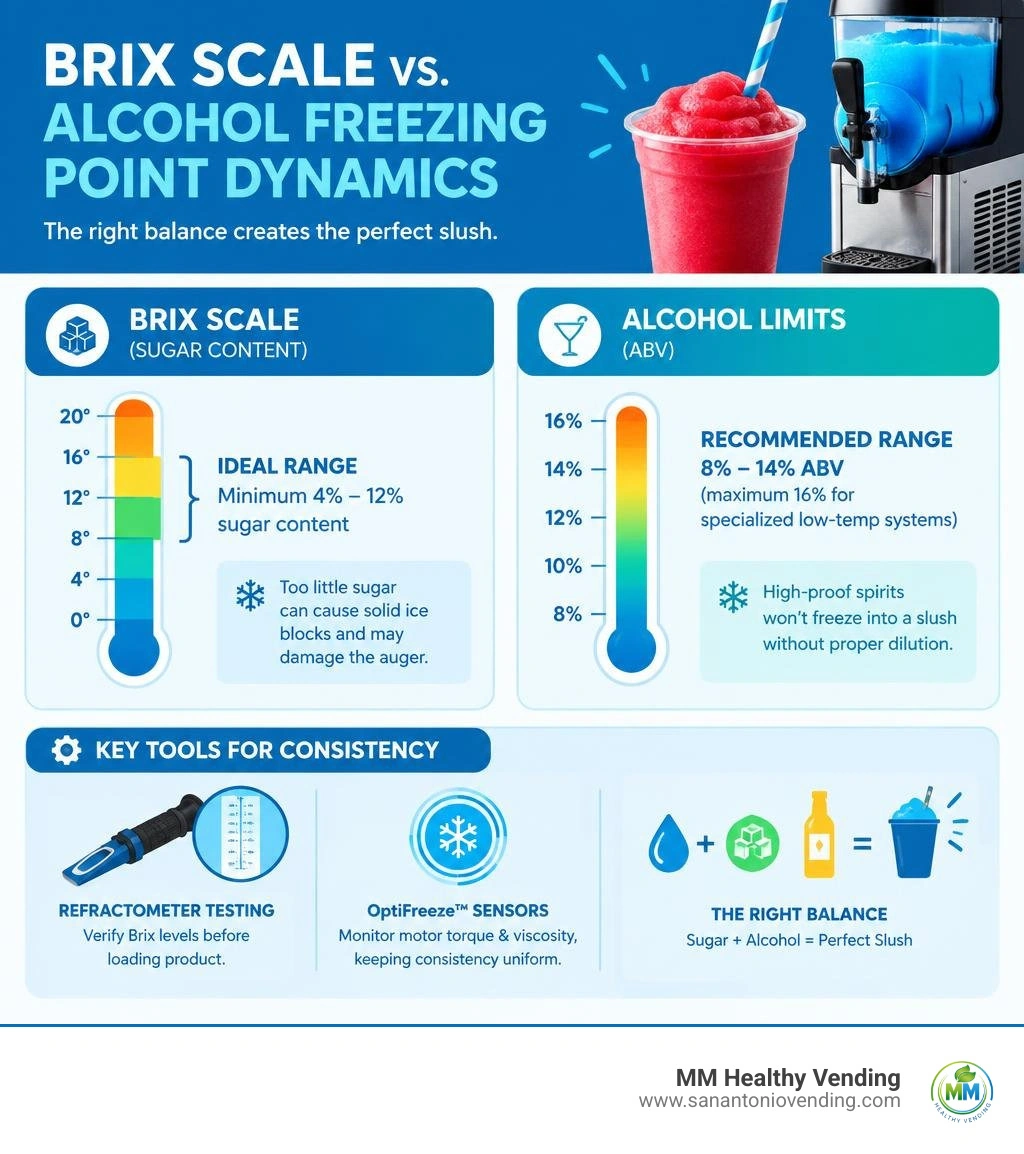
- Sugar Content (Brix): Sugar acts as a natural antifreeze that controls ice crystal formation. Commercial slush concentrates, like standard 4.5:1 mixes (which produce roughly 44 sixteen-ounce servings per gallon of concentrate), must maintain a minimum of 4% to 12% sugar content. If sugar levels drop too low, water freezes into solid ice blocks, potentially damaging the auger.
- Alcohol Limits (ABV): Ethanol depresses the freezing point significantly. Commercial pre-mix dispensers generally require alcohol levels to remain between 8% and 14% ABV (maximum 16% for specialized low-temp systems). Pouring high-proof spirits directly into the barrel without adequate dilution prevents the mix from freezing into a slush.
- Refractometer Testing: Quality commercial operators test batches using an optical refractometer to verify Brix levels before loading product into the hopper. Modern platforms also feature OptiFreeze™ sensors that continuously monitor motor torque and viscosity, dynamically adjusting compressor cycles to keep consistency uniform.
If you are expanding your business beverage program, partnering with a dependable frozen drink machine supplier ensures you get hardware matched to your exact product viscosity needs.
Installation, Maintenance, and Operating Best Practices
Proper utility setup and preventive cleaning protocols preserve equipment performance and ensure compliance with local health regulations.
Space, Electrical, and Airflow Requirements
Before delivery and installation, verify that your site satisfies these core utility requirements:
- Electrical Circuits: High-output multi-barrel FCB units typically demand dedicated 208–230V, 30A single-phase circuits fitted with NEMA L6-30R locking receptacles. Compact countertop models generally run on dedicated 115V, 15A or 20A circuits (NEMA 5-15P / 5-20P).
- Airflow Clearances: Air-cooled condensers exhaust significant thermal loads (from 9,975 to 19,000 BTU/hr). Maintain at least 6 inches of open clearance on all intake and exhaust panels (sides and rear) to avoid thermal overload and compressor failure.
- Plumbing & Gas: Pressurized units require a 3/8-inch potable water line connected through a multi-stage sediment and carbon filtration system, alongside a high-pressure food-grade CO₂ tank regulated to factory PSI specs.
Cleaning Protocols and Preventive Maintenance
Sanitation routines vary based on whether your machine is a closed-sealed bag-in-box system or an open-hopper granita model.
Closed BIB systems dramatically reduce day-to-day labor because the product remains sealed from atmospheric contaminants. However, routine lubrication of dispensing valve O-rings and monthly cleaning of condenser air filters remain vital to protect the manufacturer's 5-year sealed compressor warranty.
Frequently Asked Questions About Commercial Beverage Machines
How do sugar content and ABV levels affect frozen beverage consistency?
Sugar (measured in degrees Brix) and alcohol (ABV) lower the freezing temperature of liquids. Sugar controls the size of ice crystals, yielding a smooth slush rather than a solid block. Alcohol depresses the freezing point even further. Recipes with less than 4% sugar freeze rock-hard, straining the auger motor, while recipes with more than 16% alcohol struggle to freeze at all in standard commercial barrels.
What is the typical recovery time for high-volume commercial dispensers?
Premium commercial frozen beverage machines generally achieve a 4-minute recovery cycle. With cooling capacities ranging between 10,000 and 19,000 BTU/hr, these systems rapidly drop incoming liquid from ambient or pre-chilled hopper temperatures down to 24°F–28°F, ensuring back-to-back drink service during peak operational rushes.
What electrical and utility connections are required for installation?
Commercial countertop units usually require a dedicated 115V, 15A or 20A circuit. Larger multi-barrel, air-cooled machines require a dedicated 208–230V, 30A line with a NEMA L6-30R outlet. Pressurized carbonated units also require a continuous potable water supply (minimum 30–50 PSI) equipped with water filtration, along with a food-grade CO₂ tank and regulator.
Conclusion
A commercial frozen beverage program delivers some of the highest gross margins in the foodservice sector. Whether serving classic carbonated slushies, iced coffees, or craft frozen cocktails, matching your equipment’s draw rates, refrigeration capacity, and footprint to your expected volume is the key to lasting success.
If you are an enterprise, manufacturing facility, or commercial workplace across San Antonio, New Braunfels, Boerne, Schertz, Seguin, Helotes, or Alamo Heights seeking to upgrade your breakroom amenities, MM Healthy Vending provides fully managed, zero-cost refreshment programs. From automated smart coolers and micro-markets to custom breakroom setups, our team handles installation, regular stocking, and rapid 2-hour local support. Discover our comprehensive commercial refreshment services to give your team and guests a premium refreshment experience.
You might also like...
More articles like the one you've read to keep you up-to-date on all things vending in San Antonio
Why San Antonio businesses choose us
Premium service, local expertise, cutting-edge technology
AI-powered smart coolers
Advanced computer vision technology for seamless, cashless transactions. Just grab what you need and go.
cashless
24/7 service
Round-the-clock support with an average 2-hour response time for any issues.
Local & trusted
Family-owned business proudly serving San Antonio since 2024
Ready to upgrade your breakroom?
Join hundreds of San Antonio businesses enjoying free, premium vending soutions