Smart Vending Machine Price Guide: Upfront Costs vs Telemetry Fees
Learn the true smart vending machines cost with our guide comparing upfront prices vs telemetry fees for 2026.
What Smart Vending Machines Cost in 2026
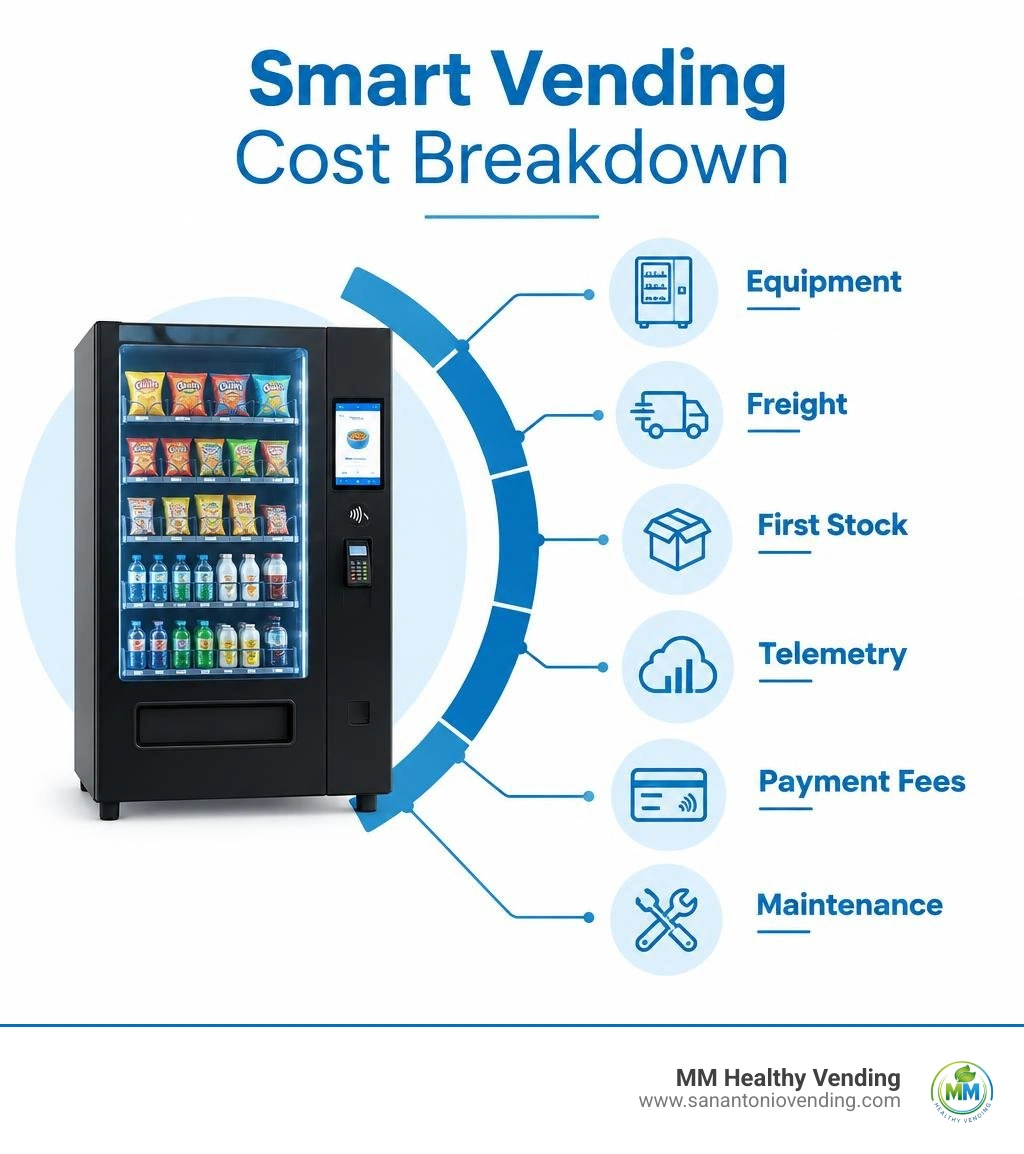
In 2026, smart vending machines cost about $3,000 to $6,000 for a basic cashless unit. Touchscreen machines typically run $6,000 to $12,000, vision-based grab-and-go coolers $4,000 to $17,000, and specialty machines $8,000 to $25,000 or more. The purchase price is only the start: freight, first stock, payment fees, software, and maintenance add to the total cost.
Those ongoing costs matter as more sites adopt smart vending. For San Antonio businesses that want the service without buying equipment, MM Healthy Vending provides free, fully managed vending machines and AI coolers with two-hour local support.
I'm Manuel Mojica, a San Antonio vending operator who has built a seven-figure automated retail business and deployed smart coolers and remote monitoring. I'll use that experience to show what smart vending machines cost upfront and over time.
Easy smart vending machines cost word list:
Smart Vending Machines Cost Breakdown by Equipment Tier
The automated retail market is expanding rapidly. The global smart vending market expansion is projected to reach $21.5 billion by 2033, driven largely by consumer demand for frictionless retail, cashless checkout, and instant product availability.
When evaluating equipment for a commercial property in San Antonio, New Braunfels, or Boerne, understanding the hardware tiers is the first step toward building an accurate capital budget.
| Equipment Tier | Upfront Price Range | Core Features | Best Suited For |
|---|---|---|---|
| Connected Basics | $3,000 – $6,000 | MDB card reader, basic telemetry, drop sensors | Small offices, breakrooms, standard commercial sites |
| Interactive Touchscreens | $6,000 – $12,000 | HD display, video ads, digital planograms, nutritional info | High-footfall transit hubs, large corporate lobbies |
| Vision-Based Smart Coolers | $4,000 – $17,000 | AI cameras, weight-sensing shelves, grab-and-go | Gyms, medical centers, premium apartment complexes |
| Specialty Smart Formats | $8,000 – $25,000+ | Robotic elevators, heated prep, fresh food safety locks | Hospitals, 24/7 manufacturing plants, universities |
Connected Basics and Cashless Units ($3,000 – $6,000)
Entry-level connected units represent the traditional coil or conveyor footprint updated for modern retail. These units utilize standard Multi-Drop Bus (MDB) protocols to integrate cashless payment hardware and internal cellular modems.
As outlined in our comprehensive commercial vending machine pricing guide, these machines give operators remote access to basic sales data and drop-sensor verification. This ensures customers are not charged if an item fails to vend, significantly reducing refund requests.
Interactive Touchscreen and Video Kiosks ($6,000 – $12,000)
Stepping up into interactive digital kiosks introduces high-definition touchscreen interfaces that replace traditional push buttons. These systems feature dynamic digital planograms, cart checkout capabilities (allowing consumers to buy multiple items in one transaction), and on-screen nutritional displays.
Operators can leverage remote content management systems to push promotional advertising or change product configurations on the fly. You can read more about these display setups in our smart vending solutions guide.
Vision-Based Grab-and-Go Smart Coolers ($4,000 – $17,000)
Vision-based smart coolers remove the mechanical dispensing hardware entirely. Instead of coils, these units use high-speed interior computer vision cameras and weight-sensitive shelf sensors. Customers simply tap their card or mobile wallet, open the glass door, take whatever items they want, and close the door.
The machine automatically bills their payment method for the items removed. We explore the frictionless mechanics of these devices in our AI smart cooler technology breakdown.
Specialty Smart Formats and Fresh Food Units ($8,000 – $25,000+)
Specialty units handle delicate or temperature-sensitive goods. These machines include automated temperature health safety locks (which automatically disable purchasing if refrigeration temps rise above safety thresholds), bean-to-cup espresso systems, or soft-drop robotic elevators designed to handle fragile fresh meals and glassware. Due to specialized refrigeration compressors and complex robotics, capital costs represent a major investment.
The True Cost of Ownership: Upfront Capital vs. Monthly Telemetry Fees
Many first-time vending buyers make the mistake of focusing strictly on the upfront sticker price. In automated retail, equipment depreciation, software licensing, cellular connectivity, and payment processing fees form a substantial portion of your operating costs over time.
Monthly Operating Expenses: Telemetry, SaaS, and Card Processing
Operating a smart machine involves ongoing monthly overhead that traditional mechanical units never incurred:
- Cellular IoT and Telemetry: Every smart machine requires a secure 4G/5G cellular data link to communicate sales, temperature data, and diagnostics to the cloud. This averages $10 to $25 per month.
- Cloud Dashboard and AI Licensing (SaaS): Access to real-time inventory management software, remote planogram portals, and AI computer vision processing engines runs between $30 and $100 per month per machine.
- Merchant Processing Fees: Contactless cards and mobile wallets carry interchange and gateway processing costs. These typically sit around 5% to 6% of gross revenue (or roughly $0.10 to $0.15 per transaction plus 2.5% to 3.5%).
- Utility Overhead: Commercial smart refrigeration, display screens, and continuous computing draw steady electricity, adding $15 to $35 per month to utility bills.
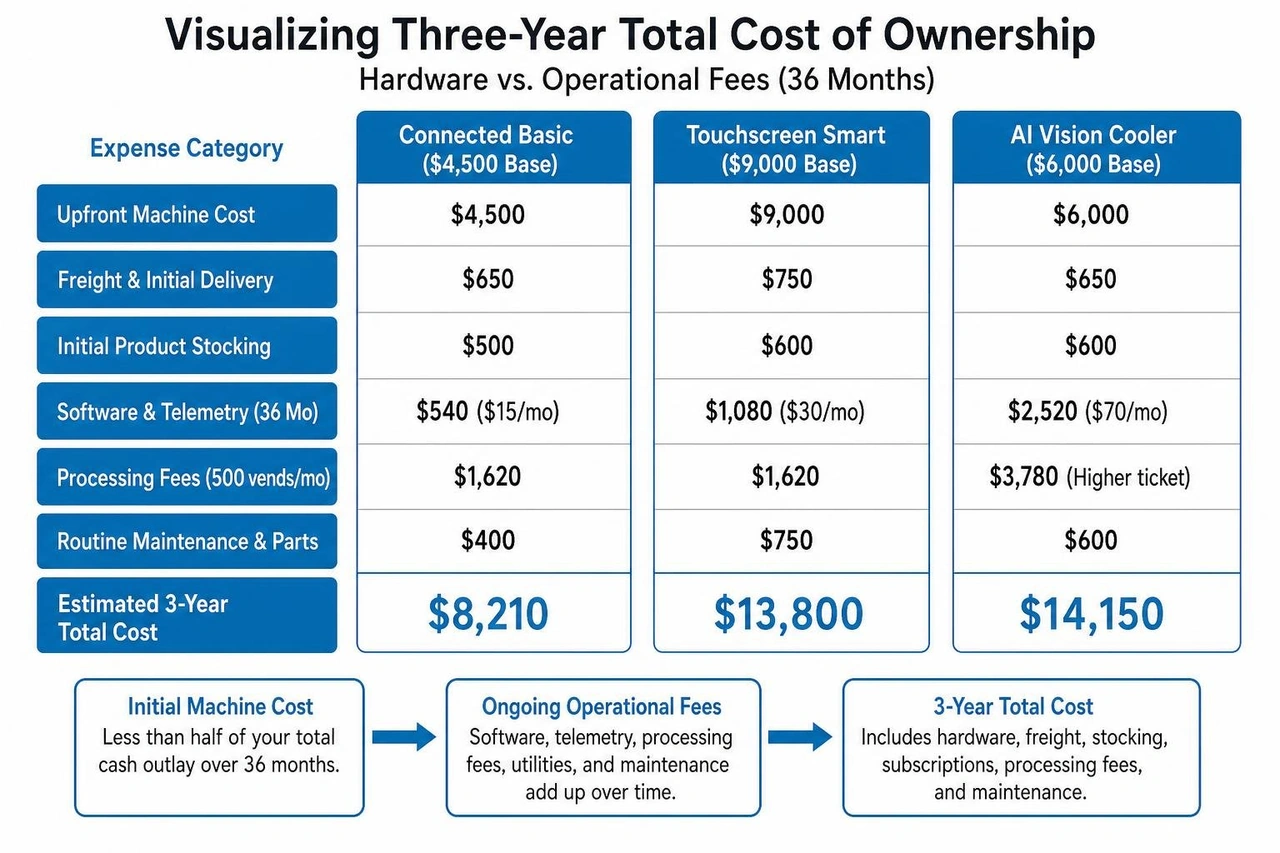
| Expense Category | Connected Basic ($4,500 Base) | Touchscreen Smart ($9,000 Base) | AI Vision Cooler ($6,000 Base) |
|---|---|---|---|
| Upfront Machine Cost | $4,500 | $9,000 | $6,000 |
| Freight & Initial Delivery | $650 | $750 | $650 |
| Initial Product Stocking | $500 | $600 | $600 |
| Software & Telemetry (36 Mo) | $540 ($15/mo) | $1,080 ($30/mo) | $2,520 ($70/mo) |
| Processing Fees (500 vends/mo) | $1,620 | $1,620 | $3,780 (Higher ticket) |
| Routine Maintenance & Parts | $400 | $750 | $600 |
| Estimated 3-Year Total Cost | $8,210 | $13,800 | $14,150 |
Analyzing Total Three-Year Smart Vending Machines Cost
When looking at a baseline scenario of 500 monthly transactions over a 36-month timeline, the initial machine purchase price often accounts for less than half of your total cash outlay. For instance, a connected basic machine purchased for $4,500 easily hits more than $8,000 to $9,000 in total operating capital once you incorporate shipping, inventory stocking, software subscriptions, and merchant interchange charges.
Understanding this dynamic is critical when evaluating a 24-hour vending machine cost breakdown for round-the-clock facilities like manufacturing plants in Schertz or Seguin.
Hidden Capital Expenditures: Freight, First Fill, and Custom Wraps
Before a machine generates its first dollar of revenue, several initial capital expenses must be funded:
- Freight and Liftgate Delivery: Vending equipment weighs between 600 and 900 pounds. Specialized freight delivery with liftgate and inside-placement services generally adds $500 to $900.
- Initial Product Stocking (First Fill): Fully loading a high-capacity machine with premium beverages, fresh food, or healthy snacks requires $400 to $800 in wholesale inventory.
- Custom Vinyl Branding: Wrapping a machine with customized corporate branding or aesthetic themes adds $300 to $650.
- Local Permits and Insurance: Depending on commercial property requirements across Alamo Heights or Helotes, general liability policies and localized health certifications can add another $200 to $500 annually.
Smart Features ROI: Which Upgrades Justify the Investment?
Investing in smarter hardware makes sense when the technology directly increases revenue velocity or slashes field operating costs. The latest commercial AI vending advancements show that intelligent automation fundamentally changes consumer purchasing behavior.

Cashless Payment Readers and Telemetry Tracking
Cashless acceptance is no longer an optional upgrade; it is standard operating protocol. Modern consumers rarely carry bills or coins. Installing cashless hardware and telemetry offers two major financial returns:
- Immediate Revenue Lift: Adding tap-to-pay and mobile wallet acceptance consistently lifts machine gross sales by 30% to 50% compared to cash-only units.
- Optimized Service Routing: Telemetry gives operators exact product counts from any computer or smartphone. Instead of making unnecessary physical site visits to check stock, service routes are planned around actual consumption, reducing truck rolls and fuel expenses by 20% to 30%.
AI Computer Vision and Grab-and-Go Shelving
Frictionless grab-and-go coolers eliminate the frustration of mechanical coil jams. By allowing customers to physically pick up and inspect product packaging before purchasing, AI smart vending machines drive multi-item transactions.
Rather than buying a single bottle of water, a consumer naturally grabs an energy bar and a protein drink simultaneously. This lifts average transaction values from the traditional $1.75 range up to $5.00 to $9.00.
Revenue Lift Requirements to Break Even on Premium Tiers
Upgrading from a connected basic machine to an interactive touchscreen unit typically costs an extra $4,500 to $5,000 across a three-year period (roughly $125 to $140 per month in amortized capital and higher software fees).
Assuming a standard wholesale gross profit margin of 50%, the upgraded machine needs to generate roughly $250 to $280 in additional gross sales per month (approximately a 20% to 25% revenue lift over a standard $1,100 monthly baseline) simply to cover its technological premium.
In locations with high daily foot traffic (such as medical plazas or corporate headquarters), that hurdle is easily cleared. In a quiet 30-person office, a basic connected machine or a zero-cost managed service is far more financially sound.
Traditional vs. Smart Vending Economics and Retrofit Options
Understanding how smart hardware compares against older, legacy mechanical equipment helps operators match the right unit to the right commercial space.
| Performance Metric | Traditional Mechanical Combo | Smart AI Vision Cooler |
|---|---|---|
| Upfront Purchase (New) | $3,500 – $6,000 | $4,000 – $10,000 |
| Average Transaction Size | $1.50 – $2.50 | $4.00 – $10.00 |
| Typical Monthly Revenue | $500 – $1,800 | $1,500 – $6,500 |
| Restocking Logistics | Fixed schedule / Manual counts | Dynamic routing / Cloud inventory |
| Mechanical Jam Risk | Moderate (Coil/Drop dropouts) | Zero (Open shelf architecture) |
For a complete breakdown of operational considerations across both formats, review our smart vending machines comprehensive guide.
Retrofitting Existing Coil Machines with Smart Hardware
If you already own functional legacy vending equipment with an MDB-compatible control board, buying brand-new machinery is not always necessary. Retrofitting allows you to capture the primary benefits of cashless sales and telemetry tracking at a fraction of the cost:
- Cashless Telemeter Hardware Kit: $250 to $500 per machine.
- MDB Control Board Upgrade (if needed for older units): $200 to $400.
- Drop Sensor Retrofit Kit: $150 to $250.
For under $800 total, an older coil machine can be modernized with card acceptance, remote sales logging, and cloud alerts.
How Section 179 Lowers the Real Smart Vending Machines Cost
Commercial buyers purchasing new smart vending equipment can leverage federal tax incentives to reduce their net capital expenditure. Under Section 179 of the Internal Revenue Code, qualifying businesses can deduct up to 100% of the purchase price of eligible equipment placed into service during the tax year, rather than depreciating the asset slowly over five to seven years.
For a business purchasing a $9,000 interactive smart machine in a 25% corporate tax bracket, taking the full deduction upfront can yield an immediate tax savings of approximately $2,250, bringing the net effective equipment cost down to $6,750. Consult a certified public accountant to confirm your specific tax eligibility.
Practical Upgrade Roadmap for New Operators
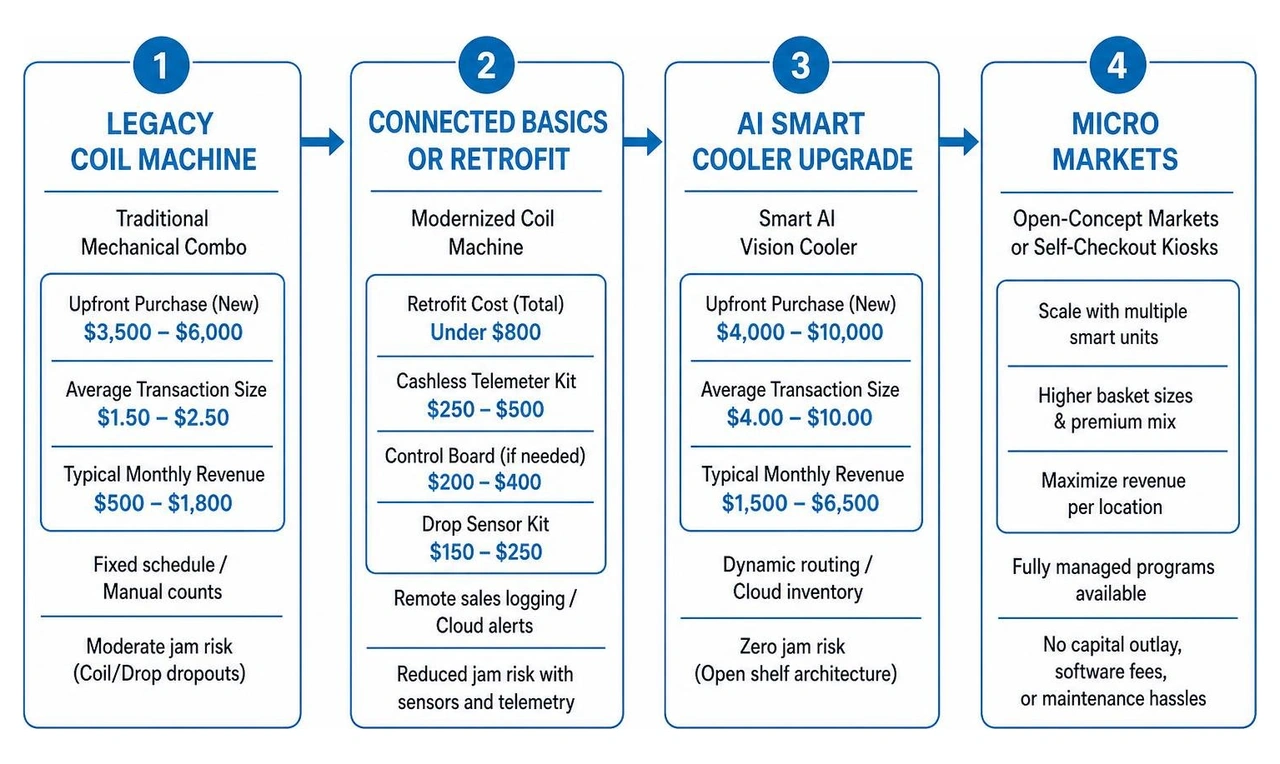
- Validate Foot Traffic First: Do not deploy an expensive $12,000 machine into an unproven account. Start by evaluating daily traffic; sites with fewer than 75 daily visitors rarely justify high-capex vision kiosks.
- Deploy Connected Basics or Modernized Retrofits: Test employee demand, determine popular product categories, and confirm site consistency with entry-level connected hardware.
- Upgrade High-Performing Locations: When monthly sales consistently exceed $1,500 on a basic machine, replace it with an AI smart cooler to capture larger basket sizes and expand premium product offerings.
- Transition to Micro Markets: When a single location demands multiple machines, expand into open-concept micro markets or unattended self-checkout kiosks.
- Leverage Fully Managed Programs: For property owners who want modern smart equipment without capital outlay, software fees, or maintenance hassles, partnering with our zero-cost vending machine programs offers a streamlined, hands-off solution.
Frequently Asked Questions About Smart Vending Costs
How much extra monthly revenue does a smart vending machine generate compared to a traditional unit?
Smart vending machines typically generate two to three times the revenue of traditional cash-only machines in comparable locations. While traditional units average $500 to $1,800 monthly with ticket sizes under $2.50, smart AI machines generate between $1,500 and $6,500 per month. This uplift stems from accepting frictionless mobile payments, displaying clear nutritional data, and enabling multi-item grab-and-go purchases with average basket sizes between $4.00 and $10.00.
What ongoing monthly software fees should I expect for an AI smart cooler?
For an AI-enabled grab-and-go cooler, monthly recurring software expenses usually total $50 to $120 per month. This budget includes $10 to $20 for cellular IoT network access, $30 to $70 for cloud analytics and inventory management platforms, and computer vision recognition fees charged on a SaaS or per-transaction basis.
Is it cheaper to retrofit a traditional vending machine or buy a new smart unit?
Retrofitting is substantially cheaper upfront, costing between $300 and $800 for a cashless telemeter and updated control harness, compared to spending $4,000 to $12,000 on a new smart machine. However, retrofitting only adds card payments and basic telemetry to a coil system. It cannot provide the open-shelf grab-and-go experience or computer vision checkout that drives higher transaction values.
Conclusion
Determining whether the smart vending machines cost aligns with your operating budget requires weighing equipment hardware prices against monthly telemetry subscriptions, maintenance needs, and realistic sales volume. While basic connected machines start around $3,000 to $6,000, specialized AI kiosks and interactive units can require upwards of $10,000 to $15,000 once fully deployed.
For commercial property managers, industrial facilities, and office spaces throughout San Antonio, New Braunfels, and Boerne looking to provide employees and visitors with modern refreshment technology without spending capital, MM Healthy Vending eliminates the financial risk. We provide premium smart coolers, modern combo machines, and healthy smart snack vending programs at zero equipment cost, backed by our dedicated 2-hour local support.
You might also like...
More articles like the one you've read to keep you up-to-date on all things vending in San Antonio

Why San Antonio businesses choose us
Premium service, local expertise, cutting-edge technology
AI-powered smart coolers
Advanced computer vision technology for seamless, cashless transactions. Just grab what you need and go.
cashless
24/7 service
Round-the-clock support with an average 2-hour response time for any issues.
Local & trusted
Family-owned business proudly serving San Antonio since 2024
Ready to upgrade your breakroom?
Join hundreds of San Antonio businesses enjoying free, premium vending soutions