The Practical Guide to Sourcing Quick Local Vending Machine Repair
Find quick local vending machine repair with our guide on costs, technician vetting, and the 50% rule to cut downtime.

How to Get Local Vending Machine Repair Fast
Start with the company that owns or services the machine. Give them the location, machine model, error message, and a photo of the problem. Ask when a technician can arrive and whether they have the likely parts. If you own the machine, compare local repair providers by the brands they service, response time, trip fee, labor rate, and parts warranty before you book.
A nearby technician can often get to the site faster, but the right parts and clear pricing matter just as much. I'm Manuel Mojica. I run a San Antonio-based vending, smart cooler, and micro-market operation, and my experience with local vending machine repair has taught me to check all three before dispatch.

Know your local vending machine repair terms:
Common Vending Machine Failures and Real Repair Costs
When a machine goes dark or refuses to vend, every passing hour eats into your profit margins. Across a typical route, operators spend an average of $50 to $150 per machine per month on maintenance and repairs. Most routine hardware issues cost between $15 and $400 to resolve, but complex refrigeration failures can escalate quickly.
| Failure Type | Common Root Cause | Typical Parts Cost | Labor & Service Call | Total Repair Range | Revenue Risk Level |
|---|---|---|---|---|---|
| Spiral / Motor Jam | Broken gears, misalignment | $15 – $80 | $0 (DIY) – $150 | $15 – $230 | Low (Single Column Out) |
| Bill Validator Fault | Dirty optical sensors, worn belts | $150 – $350 | $75 – $150 | $225 – $500 | High (~$67/day lost sales) |
| Coin Mech Jam | Bent rejector, debris in coin path | $120 – $300 | $75 – $150 | $195 – $450 | Moderate |
| Cashless Reader Outage | SIM card signal drop, loose MDB cable | $50 – $250 | $0 (DIY) – $120 | $50 – $370 | Critical (60-80% of sales) |
| Main Control Board | Power surge, blown relay | $180 – $450 | $95 – $175 | $275 – $625 | Critical (Entire machine down) |
| Dirty Condenser Coils | Dust buildup, restricted airflow | $0 – $15 | $0 (DIY) – $120 | $0 – $135 | Moderate (Compressor hazard) |
| Refrigeration Compressor | Overheating, refrigerant leak | $350 – $700 | $150 – $350 | $450 – $1,050 | Critical (Perishables lost) |
Without structured maintenance, a vending machine can be out of order up to 10% of the working year. A broken bill validator on a unit generating $2,000 monthly costs roughly $67 every single day it sits idle. Keeping spare parts on hand and understanding component vulnerabilities keeps machines running smoothly.
Payment Systems and Mechanical Delivery Issues
Payment system failures represent the vast majority of urgent repair calls. When a bill acceptor jams or a coin mechanism rejects valid currency, prospective buyers walk away empty-handed. In fact, a study by TOMRA showed that 31% of users simply go elsewhere when an automated retail or deposit machine fails.

- Bill Acceptors: These units rely on precise optical lenses and drive belts. Dust, worn rubber, and wrinkled bills cause jams. Cleaning or replacing internal belts often fixes the issue, but older non-MDB bill validators may require full replacement.
- Coin Mechanisms: Modern multi-drop bus (MDB) coin mechs rely on micro-switches and optical gates. Debris or coin jams frequently freeze payout tubes.
- Cashless Telemetry: When card readers lose cellular connectivity, you lose the lion's share of modern transaction volume. Diagnosing cashless readers starts with checking antenna placement, cellular signal strength, and firmware stability.
- Delivery Motors & Spiral Coils: Delivery coils driven by 24V DC fractional motors can experience gear stripping or misalignment. Modern machines feature optical drop sensors (like Golden Eye or infrared drop sensors) that detect whether a product falls, automatically giving the customer another selection if an item hangs.
For comprehensive operational upkeep, our full vending machine service framework helps route managers keep every mechanical assembly operating within manufacturer specifications.
Refrigeration and Control Board Breakdowns
Refrigerated units make up roughly 30% of all vending machines in operation, but they account for the majority of expensive service tickets.
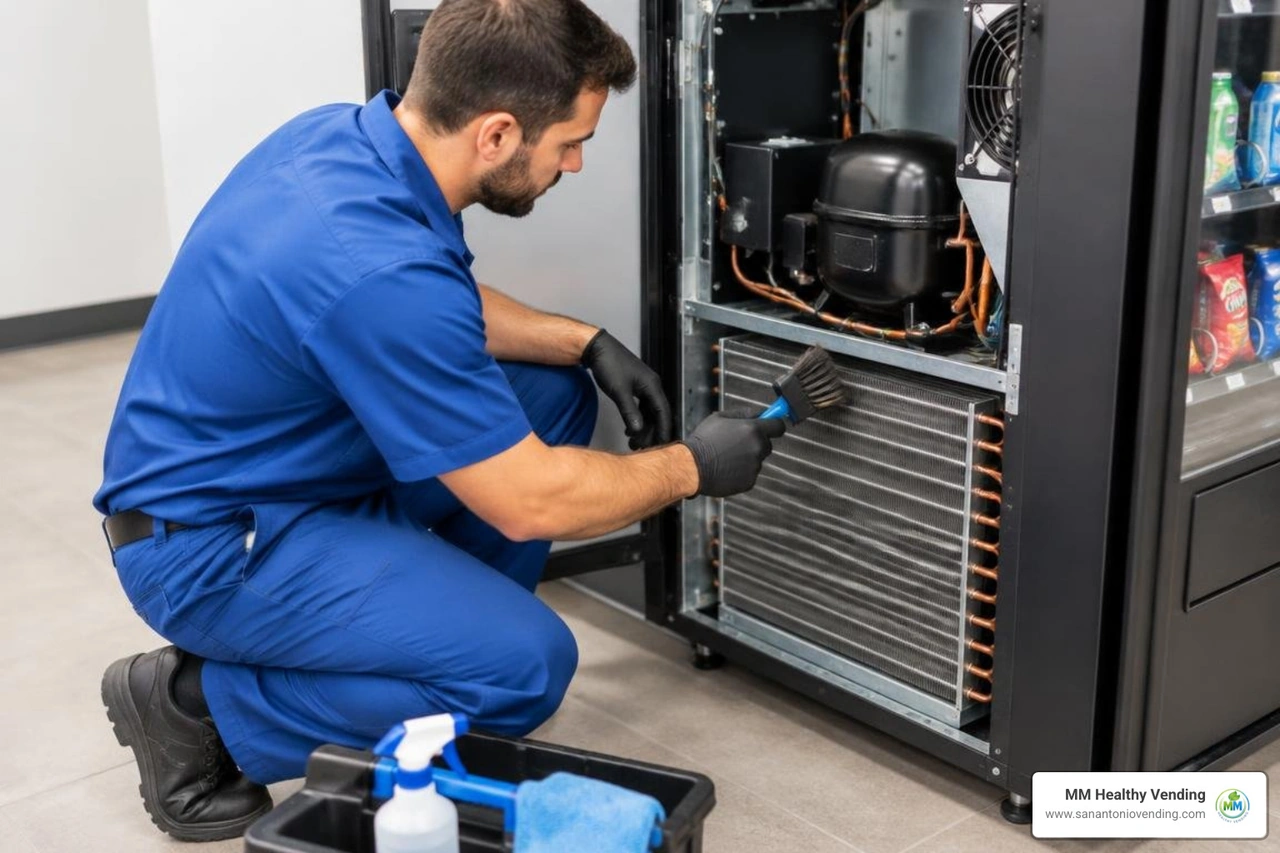
- Condenser Coils: A dirty, lint-choked condenser is the single leading cause of compressor failure. It forces the compressor to run hotter and longer, drastically shortening its life. Brushing and vacuuming your coils is a completely free maintenance step that prevents a $1,000 breakdown.
- Compressors: When a sealed refrigeration deck fails, replacement costs run between $450 and $1,050 when factoring in certified labor and refrigerants.
- EPA Certification: Under Section 608 of the Clean Air Act, any technician opening the sealed refrigeration system or handling regulated refrigerants (such as R134a or R290) must hold active EPA Universal certification. Attempting DIY refrigerant charges without licensing and recovery equipment carries severe federal penalties.
- Main Control Boards: The brain of any machine is its logic board, orchestrating the MDB protocol, temperature sensors, drop detection, and DEX audits. Voltage spikes from unstable commercial wall outlets can fry board relays, leading to erratic vending behavior or total system lockups.
Repair Cost Breakdown by Equipment Type
Repair costs vary widely depending on the age and sophistication of your equipment:
- Traditional Snack & Drink Combos: Built with straightforward 24V motors, passive wiring harnesses, and modular bill acceptors. Routine repairs are affordable, generally costing between $50 and $200.
- Refurbished Brand-Name Units (AMS, Crane, Dixie Narco): Highly reliable with extensive third-party parts availability. Component swaps are fast and budget-friendly.
- Smart Coolers: High-tech units that incorporate interior computer vision cameras, weight sensors, automated electronic door latches, and integrated edge computing hardware. If you operate connected equipment, review our detailed guide to AI cooler maintenance to keep smart sensors, firmware, and locking mechanisms properly calibrated.
- Micro-Market Kiosks: Self-checkout kiosks rarely suffer mechanical jams, but they require software maintenance, barcode scanner recalibrations, and touchscreen replacements ($200 to $500).
How to Find and Vet Local Vending Machine Repair Technicians
Finding a dependable technician requires evaluating geographic proximity, technical certifications, and component availability.
When building your local repair network, consult industry resources like the Vending Machine Repair & Service Companies Directory to locate independent specialists. Make sure any provider you hire actively covers your immediate submarket—whether you are operating in downtown San Antonio, New Braunfels, Boerne, Schertz, Seguin, Helotes, or Alamo Heights. Technicians stationed across town can easily turn a minor glitch into a multi-day revenue outage.
Key Questions to Ask Before Hiring Local Vending Machine Repair Services
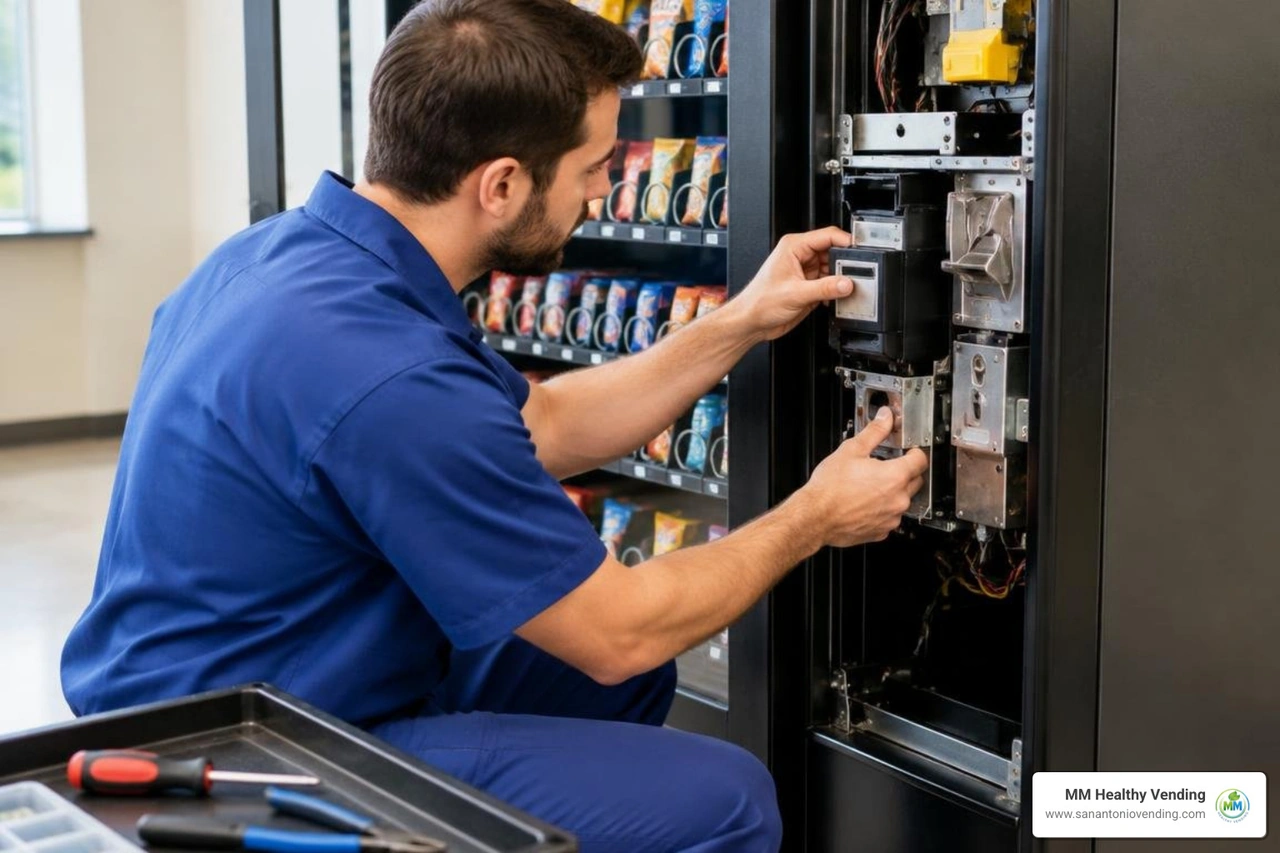
Before authorizing a repair visit, ask these five essential questions:
- "What specific equipment brands and control boards do your techs specialize in?" (Ensure they have direct experience with Crane National, AMS, USI, Dixie Narco, or Royal Vendors).
- "What is your standard on-site response window for critical outages?" (Look for companies offering rapid emergency dispatch windows).
- "Do your service vans carry common spare parts (motors, MDB harnesses, validator belts, coin mechs)?" (A tech without onboard parts turns a single service call into two separate billable visits).
- "Are your refrigeration specialists EPA Section 608 certified?" (Mandatory for cooling system repairs).
- "What warranty do you offer on replacement parts and labor?" (A professional provider stands behind their work with at least 30 to 90 days of coverage).
Comparing Labor Rates and Fees for Local Vending Machine Repair
According to May 2023 data from the US Bureau of Labor Statistics, there are approximately 36,100 coin, vending, and amusement machine service technicians in the United States, earning a mean wage of $22.04 per hour.
A professional repair service charges between $95 and $150 per billable hour, plus an initial trip fee or service call charge of $75 to $150. This covers the technician's wage, vehicle operation, diagnostic tooling, commercial insurance, and overhead.
- Standard Trip / Diagnostic Fee: $75 to $150 (covers travel and the first 15–30 minutes of troubleshooting).
- Standard Labor Hourly Rate: $95 to $150 per hour.
- Emergency / Weekend Rates: $150 to $225 per hour.
Understanding these benchmarks ensures you are paying fair market prices without sacrificing rapid response times.
The DIY vs. Professional Decision Matrix: Applying the 50% Rule
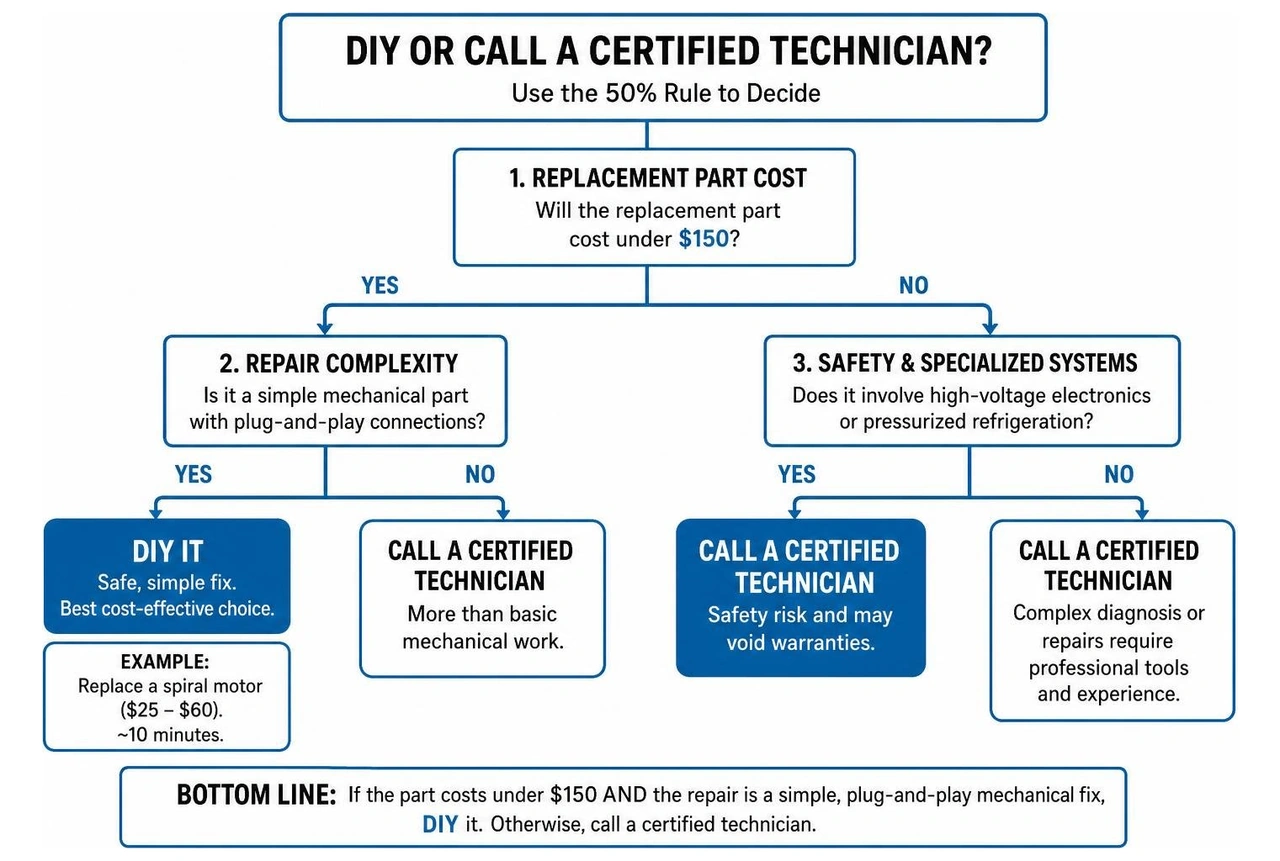
Taking a practical approach to maintenance means balancing hands-on fixes with professional intervention. Handling small mechanical adjustments yourself keeps overhead down, but tampering with high-voltage electronics or pressurized refrigeration without the right tools can create safety risks and void equipment warranties. When complex issues arise, leaning on responsive technical support prevents costly mistakes.
Minor Fixes You Can Safely DIY
If a replacement component costs under $150 and involves plug-and-play connections, handling it yourself is usually the most cost-effective path:
- Replacing a Spiral Motor: Unclip the rear wiring harness, disengage the motor retaining clip, snap in a new $25 to $60 motor, and reconnect. Total time: 10 minutes.
- Clearing Payment Jams: Open the bill validator housing to clean foreign debris, lint, or folded bills off the optical lenses with a lint-free swab and isopropyl alcohol.
- Coin Tube Replacements: Unclip stuck coin tubes on modular mechs to clear lodged coins, then run an inventory diagnostic test from the internal keypad.
- Firmware Updates & Harness Reseating: Inspect loose MDB multi-pin harnesses and plug telemetry cables firmly into the main control board.
When to Replace Instead of Repair
The standard industry guideline for aging equipment is the 50% Rule:
The 50% Rule: If the estimated cost of an immediate repair exceeds 50% of the machine's current fair-market replacement value, replace the equipment instead of fixing it.
For instance, if you operate an older, single-zone refrigerated combo machine with an estimated market value of $1,200, and its compressor fails (a $900 parts-and-labor repair), investing that cash into the aging unit is financially counterproductive. Sinking major capital into end-of-life hardware often leads to cascading failures across control boards, wiring harnesses, and payment interfaces.
Preventive Maintenance and Budgeting Strategies to Cut Downtime
Proactive maintenance delivers exceptional returns. Operators who follow a structured preventive maintenance schedule report 30% to 40% lower annual repair costs compared to those who only fix equipment after it breaks down. Routine servicing extends equipment lifespans by 2 to 3 years.
Essential Routine Maintenance Checklist
Adopt this maintenance routine across your locations:
- Every Restock Visit (Weekly / Bi-Weekly):
- Wipe down exterior touchpoints, keypads, glass panels, and cashless card bezels.
- Test spiral delivery alignment on high-volume product selections.
- Inspect the bill intake slot and clear minor dust buildup.
- Check the machine temperature display to verify proper cooling.
- Monthly:
- Inspect the door gaskets for tears, brittle rubber, or air leaks.
- Test coin mechanism payout levers and ensure coin tubes are seated properly.
- Run built-in motor diagnostic tests from the logic board menu.
- Quarterly:
- Pull the machine forward and thoroughly vacuum/brush the condenser coils.
- Clear the evaporator drain pan and check condensation drain lines for clogs.
- Inspect MDB wiring harnesses for friction wear or pinching.
- Annually:
- Deep-clean delivery bins, product shelves, and internal pushers.
- Check main board power supply voltages and terminal connectors.
- Recalibrate drop sensors and temperature cutoffs.
Annual Repair Budgeting Guidelines
To avoid unexpected maintenance bills, set aside dedicated funds using this capital allocation formula:
- Years 1–2 (New or Premium Refurbished Units): Budget 10% to 15% of the machine's purchase value annually for routine maintenance, spare parts, and minor wear.
- Years 3 and Beyond (Established Equipment): Lower your allocation to 5% to 8% of the machine value per year, provided you maintain an active preventive servicing schedule.
Frequently Asked Questions About Vending Maintenance
How much does an average vending machine service call cost?
A standard service call typically ranges between $150 and $300 total. This includes a base trip/diagnostic fee of $75 to $150 (covering travel and the initial diagnosis) plus the first hour of labor. If basic parts like switches, harnesses, or motors are needed, the invoice usually settles near the $225 to $350 range.
What is the 50% rule for broken vending equipment?
The 50% rule states that you should never spend more than 50% of a machine's current fair market value on a single repair. If a snack machine is worth $1,000 on the secondary market and requires a $600 control board and validator overhaul, replacing the machine is more cost-effective than absorbing the repair bill.
How quickly should a local technician respond to an outage?
For mission-critical outages—such as payment processor drops or cooling failures on perishable foods—a reliable local provider should offer an on-site response window within 2 to 4 hours. For non-critical issues (such as a single jammed column on a 40-selection machine), standard service within 24 to 48 hours is standard practice.
Summary & Workplace Vending Solutions
Maintaining your own vending equipment takes ongoing time, replacement parts inventory, and regular mechanical work. At MM Healthy Vending, we eliminate that maintenance burden entirely for businesses across San Antonio, New Braunfels, Boerne, Schertz, Seguin, Helotes, and Alamo Heights.
We provide modern, energy-efficient vending machines, smart AI coolers, and custom micro markets at zero cost to your business. Our experienced local team manages restocks, real-time telemetry, routine sanitation, and emergency repairs—backed by our 2-hour local support guarantee.
Upgrade your breakroom without taking on maintenance hassles by exploring our full range of managed workplace refreshment services today.
You might also like...
More articles like the one you've read to keep you up-to-date on all things vending in San Antonio
Why San Antonio businesses choose us
Premium service, local expertise, cutting-edge technology
AI-powered smart coolers
Advanced computer vision technology for seamless, cashless transactions. Just grab what you need and go.
cashless
24/7 service
Round-the-clock support with an average 2-hour response time for any issues.
Local & trusted
Family-owned business proudly serving San Antonio since 2024
Ready to upgrade your breakroom?
Join hundreds of San Antonio businesses enjoying free, premium vending soutions