
Upgrading Your Breakroom Micro Market Provider Without the Headaches
Upgrade your breakroom micro market provider without the headaches using our zero-cost, fully managed service for better tech and fresh food.
Choose a Breakroom Micro Market Provider That Can Actually Support Your Team
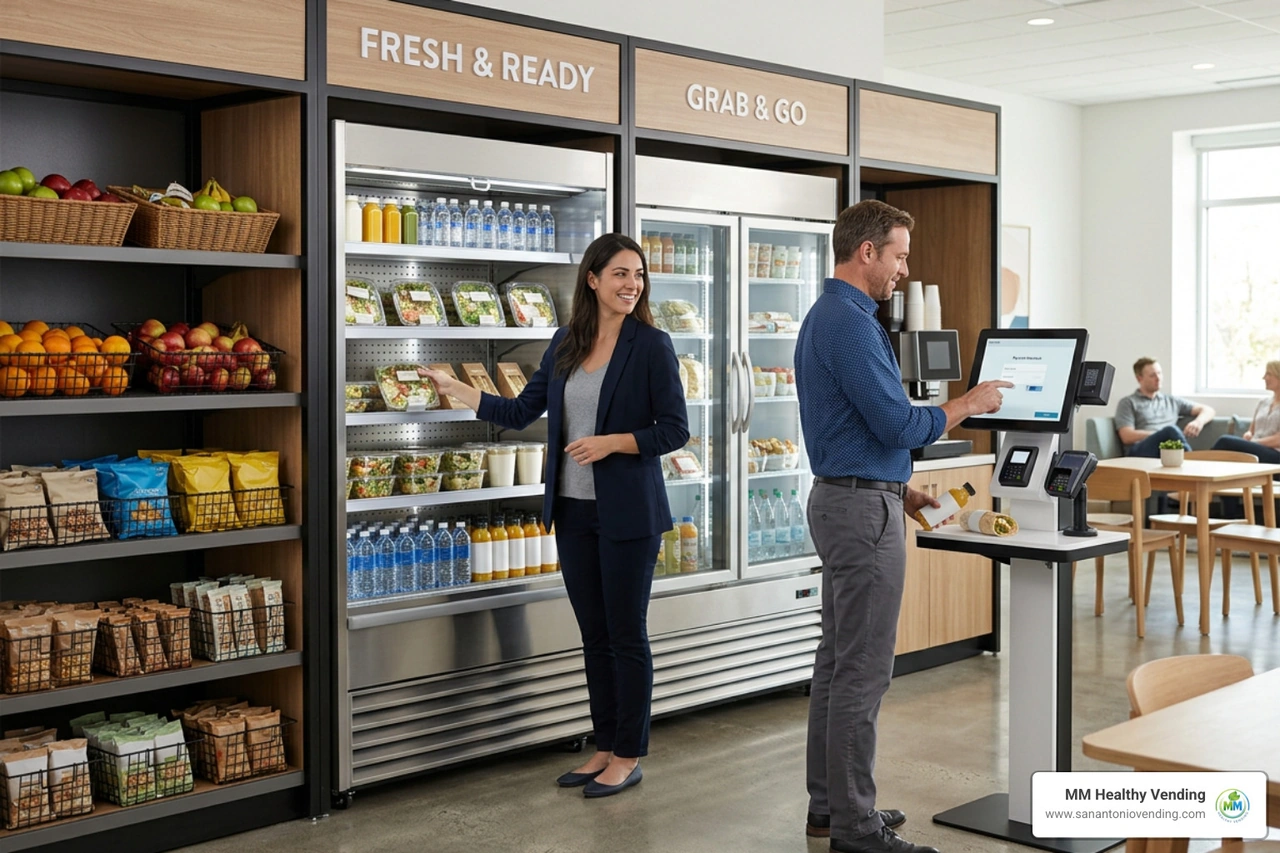
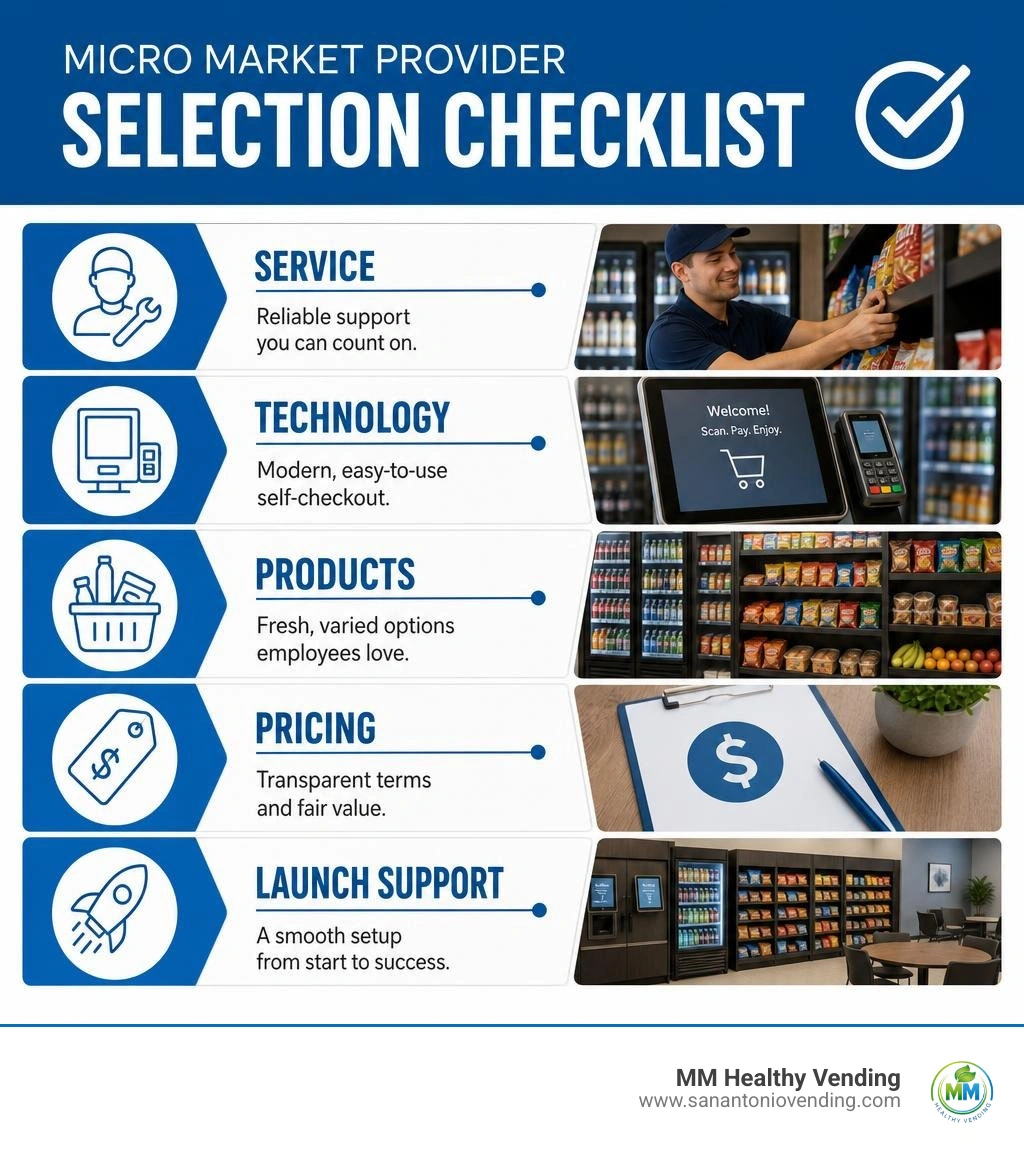
To upgrade without disruption, choose a breakroom micro market provider that offers local support, modern self-checkout technology, reliable restocking, and a clear plan for removing old equipment and launching the new space. Ask how often they service locations, how they prevent out-of-stocks, what payment methods they accept, and whether the program has upfront costs or service fees.
A micro market is an open breakroom shop with shelves, coolers, fresh food, and self-service checkout. Unlike a row of vending machines, it can offer more choice, better meal options, and flexible product mixes based on what employees actually buy. That matters when poor stock, slow service, and limited options are frustrating your workplace.
The change is worth evaluating carefully. Micro markets commonly produce higher average purchases than traditional vending, but the right provider must also make the transition simple, keep food fresh, and stay accountable after installation.
I am Manuel Mojica, a 7-figure automated-retail operator with hands-on experience in smart vending, coolers, route logistics, and micro markets across commercial locations. In this guide, I will show you how to assess a breakroom micro market provider and switch with fewer surprises.
Breakroom micro market provider glossary:
Understanding the Modern Breakroom Micro Market
The workplace breakroom has evolved far beyond a solitary coffee maker and a humming, spiral-coil snack machine that occasionally eats your dollar bills. Today, employers are reimagining break spaces as vibrant corporate hubs. Central to this evolution is the modern breakroom micro market—a custom, open-concept mini-convenience store installed directly inside your facility.
Unlike conventional vending machines, micro markets feature open shelving, reach-in commercial glass-front coolers, freezer sections, and interactive self-checkout kiosks. Employees can browse freely, pick up items to read nutritional labels, inspect fresh ingredients, and pay using a variety of digital payment options.
The growth trajectory of micro markets reflects this shift. The global micro market sector was valued at $1.2 billion in 2022 and is projected to reach $2.8 billion by 2030, expanding at a compound annual growth rate (CAGR) of 11.2%. In the United States alone, micro market locations grew by more than 20% in 2023 to reach roughly 50,000 installations. As outlined in our workplace refreshment guide for 2026, businesses are shifting from rigid dispensing units toward welcoming environments that cater to modern dining preferences.
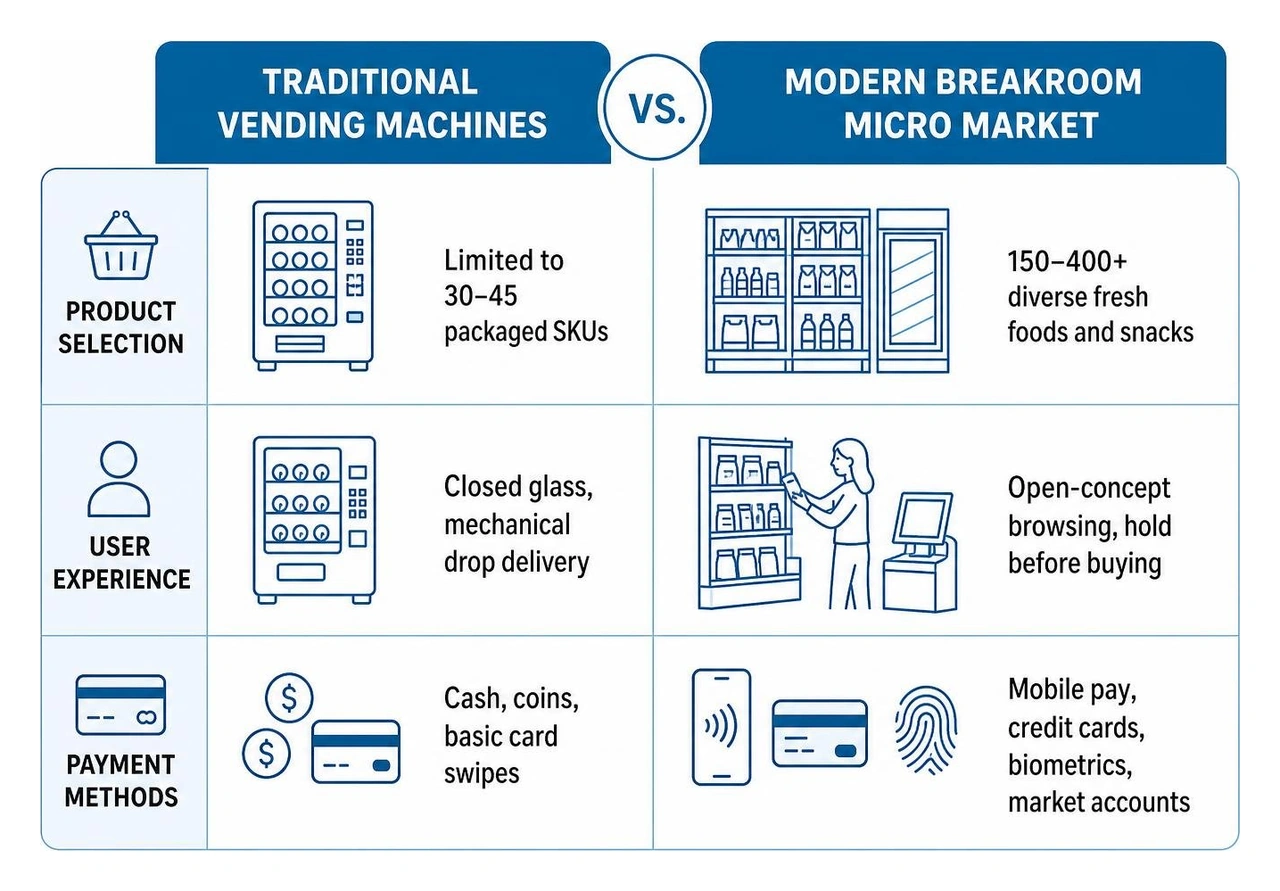
| Feature | Traditional Vending Machines | Breakroom Micro Market |
|---|---|---|
| Product Selection | Limited to 30–45 packaged SKUs | 150–400+ diverse fresh foods and snacks |
| User Experience | Closed glass, mechanical drop delivery | Open-concept browsing, hold before buying |
| Payment Methods | Cash, coins, basic card swipes | Mobile pay, credit cards, biometrics, market accounts |
| Average Ticket Size | Roughly $1.50 per transaction | $3.50 to $5.00 per transaction |
| Fresh Meal Capabilities | Minimal to none (long shelf-life only) | Salads, wraps, artisan sandwiches, fruit cups |
| Sales Performance | Baseline automated retail revenue | 30% to 50% revenue increase over vending |
| Employee Satisfaction | Functional, transactional utility | High engagement, seen as a workplace perk |
When facilities decide to revamp your office with a full service breakroom, transitioning to a micro market eliminates common frustrations such as stuck items, coin jams, and stale product lines. Instead, teams gain access to restaurant-quality lunches, functional beverages, and premium snack selections around the clock.
Key Factors to Evaluate in a Breakroom Micro Market Provider
Selecting a partner to manage your breakroom is not just about getting attractive fixtures; it requires dependable technology, rigorous food safety standards, and reliable customer service. When vetting providers in San Antonio, Boerne, Schertz, or Alamo Heights, consider these critical elements:
- Telemetry and Remote Monitoring: A premier provider uses cloud-connected inventory management systems. Every transaction is logged instantly, allowing the operator to track stock levels remotely and schedule route deliveries before popular items sell out.
- Payment Versatility: Modern setups should offer seamless contactless shopping and payment technology. Look for kiosks that accept Apple Pay, Google Wallet, tap-to-pay credit cards, reloadable company market accounts, and even biometric thumbprint authentication.
- Health and Safety Compliance: Commercial coolers must have integrated health locks. If a power outage occurs and the internal temperature exceeds safe thresholds (typically 41°F for perishable foods), the software automatically locks the cooler doors to prevent unsafe purchases.
- Energy Efficiency: Modern fixtures should use Energy Star-certified refrigeration, smart LED illumination with motion activation, and eco-friendly refrigerants to minimize electricity consumption.
- Local Response Times: Hardware glitches or connectivity hiccups can happen. Partnering with a provider that guarantees rapid, local on-site support ensures your team never faces a down market for an entire shift.
How a Breakroom Micro Market Provider Handles Restocking and Inventory
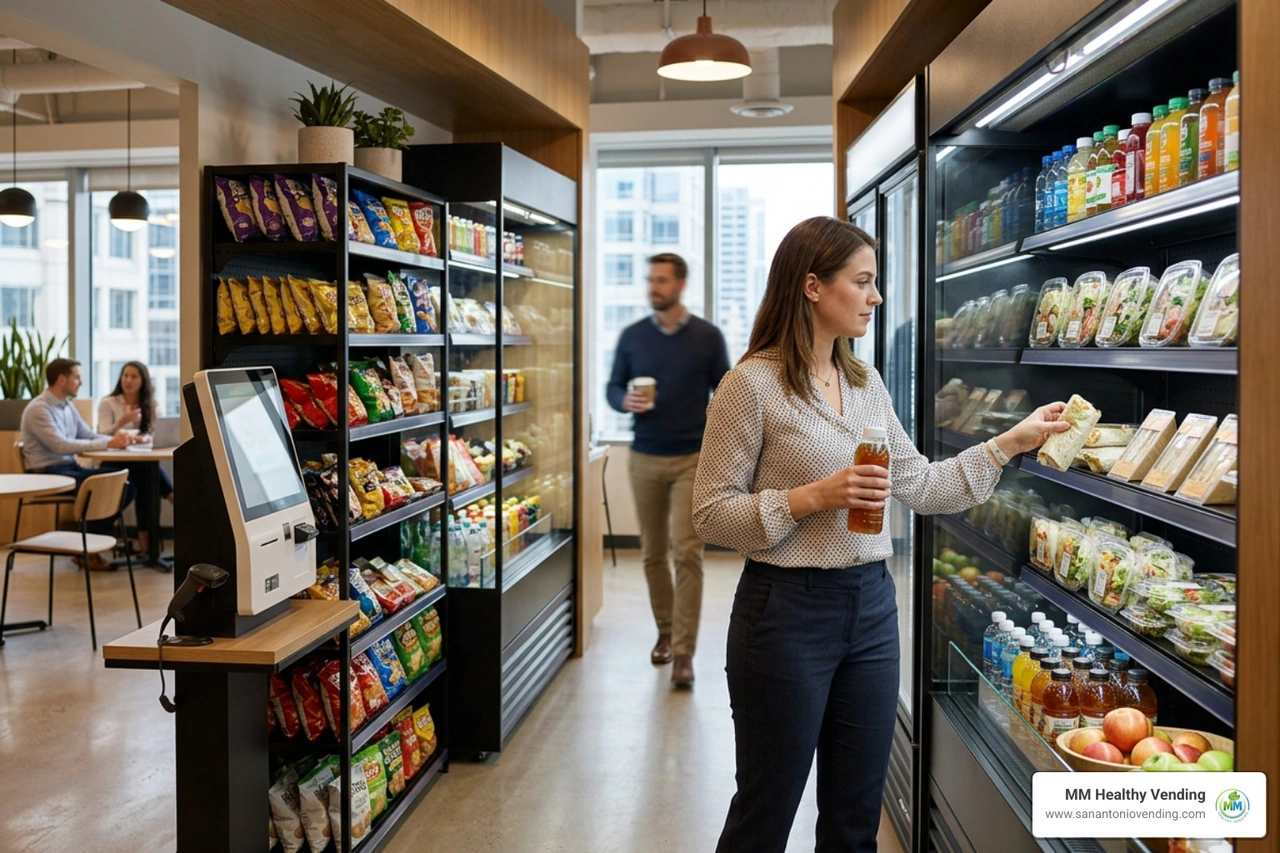
A common question facility managers ask is how inventory stays organized, fresh, and properly stocked without creating extra work for their own administrative staff.
Leading operators leverage automated inventory telemetry and AI-assisted demand forecasting. Instead of guessing what your team wants, the system tracks real-time sales patterns. If employees in your Helotes or Seguin facility show a strong preference for protein bowls and cold-brew coffees on Monday mornings, route drivers receive automated pick-lists tailored specifically to those consumption habits.
Dynamic replenishment prevents over-stocking and cuts down on food spoilage. Perishable foods are tracked by lot codes and expiration dates. Drivers pull aging items before their prime window passes, replacing them with fresh options. By installing modern micro markets for modern offices, facilities gain an automated retail system that runs smoothly in the background while keeping shelves full and organized.
Pricing Models, Service Fees, and Zero-Cost Solutions
Understanding the financial arrangements behind breakroom markets is essential for budgeting:
- Fully Managed Zero-Cost Model: The most common and popular arrangement for qualifying businesses. The provider delivers, installs, stocks, and manages the entire setup—including shelves, coolers, security cameras, and kiosks—at zero charge to the employer. The provider earns its revenue directly through retail sales.
- Subsidized Employee Wellness Programs: Some employers choose to subsidize healthy options. For instance, a company might cover 20% to 50% of the cost for fresh salads, fruits, and low-sugar snacks, while standard treats remain regular price. The checkout kiosk applies these discounts automatically, and the employer receives a monthly itemized invoice for the subsidized balance.
- Free-Vend / Full Subsidy: In competitive recruitment industries, some companies supply all snacks and beverages as a 100% employer-paid perk, using the micro market infrastructure to manage inventory and monitor consumption patterns.
Exploring zero-cost micro market solutions helps businesses upgrade their breakrooms without equipment leasing fees, capital outlays, or monthly maintenance charges.
Workplace Benefits: Productivity, Wellness, and Retention
The physical environment of an office directly impacts team morale, recruitment success, and daily productivity. Research indicates that over 70% of employees feel a well-stocked breakroom featuring fresh meal choices meaningfully increases their overall job satisfaction.

When workers have to leave the office to grab lunch or an afternoon pick-me-up, they often spend 20 to 40 minutes navigating traffic, waiting in drive-thru lines, and returning to their desks. An on-site micro market gives them nutritious options just steps from their workstations.
Key organizational advantages include:
- Elevated Energy and Focus: Fresh wraps, yogurts, nuts, and natural juices help prevent the mid-afternoon energy slumps caused by high-sugar vending snacks.
- Strengthened Workplace Wellness: By supporting micro market workplace wellness, HR teams can support health initiatives by making wholesome choices easily accessible to on-site staff.
- Measurable Time Savings: By boosting micro market workplace productivity, employers help teams spend less time off-site during short breaks, giving them more room to recharge, collaborate, and focus on their workday.
- Recruiting and Culture: A polished breakroom with modern fixtures and premium food options signals that a company values its people, serving as a visible benefit during candidate interviews and office tours.
Implementation Process: From Site Survey to Launch
Transitioning to a modern micro market is straightforward when handled by an experienced provider. A typical rollout follows a clear, step-by-step path:
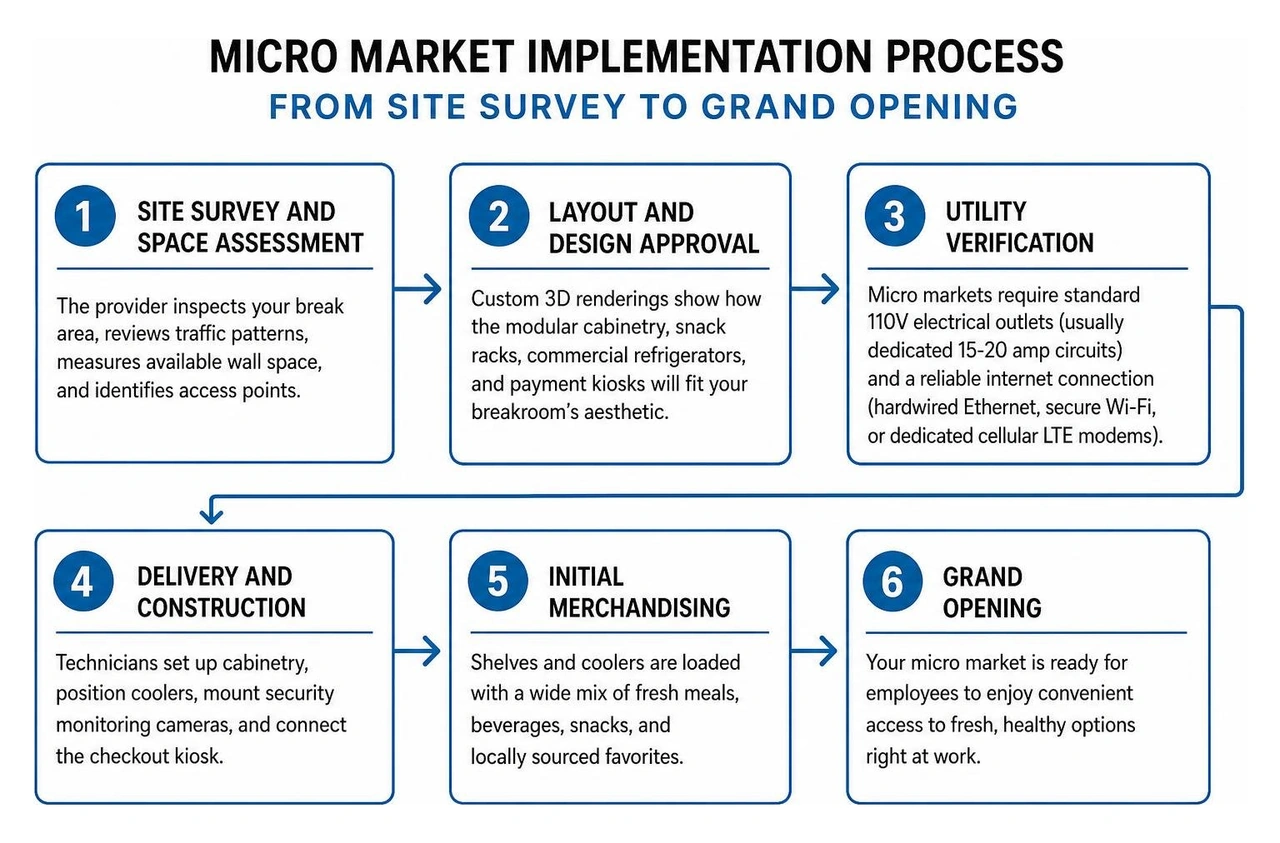
- Site Survey and Space Assessment: The provider inspects your break area, reviews traffic patterns, measures available wall space, and identifies access points.
- Layout and Design Approval: Custom 3D renderings show how the modular cabinetry, snack racks, commercial refrigerators, and payment kiosks will fit your breakroom's aesthetic.
- Utility Verification: Micro markets require standard 110V electrical outlets (usually dedicated 15-20 amp circuits) and a reliable internet connection (hardwired Ethernet, secure Wi-Fi, or dedicated cellular LTE modems).
- Delivery and Construction: Technicians set up cabinetry, position coolers, mount security monitoring cameras, and connect the checkout kiosk.
- Initial Merchandising: Shelves and coolers are loaded with a wide mix of fresh meals, beverages, snacks, and locally sourced favorites.
- Employee Launch and Onboarding: Clear signage, introductory guides, and launch-day promotions help staff get comfortable with the self-checkout system.
Reviewing our Texas micro markets guide for 2026 provides a practical look at how businesses across Southside San Antonio and surrounding areas handle logistics, utility requirements, and layout designs.
How to Seamlessly Transition to a New Breakroom Micro Market Provider
If your facility is replacing an underperforming vendor, managing the changeover without service gaps is essential. Here is how to keep the process smooth:
- Establish Clear Vendor Removal Timelines: Notify your current vendor in writing according to your contract terms, setting a specific date for them to remove their machines and settle any final balances.
- Coordinate Staged Installations: Schedule your new provider to deliver and stage fixtures immediately following the old equipment removal, keeping breakroom downtime to a minimum.
- Host a Grand Opening Tasting: High-performing operators often host launch events with free product samples, helping team members explore new healthy brands and set up their kiosk accounts.
- Maintain Clear Communication: Post notices in breakrooms a week ahead of time to let employees know about the upgrade, downtime expectations, and the new food options coming their way.
Working with an experienced team providing comprehensive break room refreshment services keeps the entire changeover organized, efficient, and headache-free.
Frequently Asked Questions About Micro Market Upgrades
How much space is required for a breakroom micro market?
Micro markets are modular and scale to fit various room dimensions. A compact footprint requires as little as 6 to 8 linear feet of wall space (accommodating a single commercial cooler, snack rack, and a compact kiosk). Larger corporate campuses with hundreds of employees can expand across 20 to 30 linear feet with multiple dual-temp coolers, dedicated freezers, hot beverage stations, and dual self-checkout kiosks.
How do micro market providers prevent theft and shrinkage?
Micro markets operate primarily on an open-honor system, supported by several loss-prevention measures:
- High-Definition Surveillance: Discreet multi-angle cameras monitor browsing and payment areas.
- Closed-Campus Environments: Markets are positioned in secure, employee-only areas rather than public lobbies.
- Account-Linked Payments: When staff scan badges, fingerprint profiles, or credit cards, transactions attach to verified individual profiles.Across corporate facilities, shrinkage rates generally track between 1% and 3%, an operational margin that experienced providers account for in their business model.
How does a micro market compare in cost to traditional vending?
For most employers, the capital cost is identical: zero dollars. Under standard full-service management agreements, the provider supplies, installs, insures, and maintains all market equipment at no cost to your business. The primary economic difference lies in product pricing and choice: micro markets offer higher-end, fresh culinary selections alongside conventional snacks, leading to higher average sales ($3.50–$5.00) compared to traditional vending machines ($1.50). For specialized locations, exploring regional micro market setups provides useful context on how modular formats match different workforce sizes.
Conclusion
Upgrading your breakroom should feel like an exciting workplace perk, not a complex logistical project. By choosing an experienced operator that delivers flexible equipment designs, reliable inventory monitoring, fresh local foods, and fast customer service, you can turn your break area into a hub that supports team morale and daily productivity.
At MM Healthy Vending, we deliver turnkey, zero-cost breakroom micro markets and automated retail programs to businesses across San Antonio, New Braunfels, Boerne, Schertz, Seguin, Helotes, and Alamo Heights. Our managed services include high-tech self-checkout kiosks, Energy Star coolers, curated product menus, and a dedicated 2-hour local support commitment.
If you are exploring traditional machine upgrades alongside open-market designs, check out our custom traditional vending and refreshment alternatives to find the right automated retail solution for your team. Contact us today to schedule a site evaluation and take the first step toward an upgraded breakroom experience.
You might also like...
More articles like the one you've read to keep you up-to-date on all things vending in San Antonio


Why San Antonio businesses choose us
Premium service, local expertise, cutting-edge technology
AI-powered smart coolers
Advanced computer vision technology for seamless, cashless transactions. Just grab what you need and go.
cashless
24/7 service
Round-the-clock support with an average 2-hour response time for any issues.
Local & trusted
Family-owned business proudly serving San Antonio since 2024
Ready to upgrade your breakroom?
Join hundreds of San Antonio businesses enjoying free, premium vending soutions