
Maximizing Office Efficiency with Smart Convenience Solutions
You maximize office efficiency with smart convenience solutions by systematically removing the administrative friction from your employees' daily routines.

You maximize office efficiency with smart convenience solutions by systematically removing the administrative friction from your employees' daily routines. This means automating front-desk check-ins, digitizing workspace booking, implementing self-service equipment kiosks, and moving away from physical keys and badges. When you integrate hardware and software to handle these routine tasks, your staff spends less time navigating broken processes and more time focused on their actual work.
Efficiency in a workspace is rarely about making people work faster. Instead, it is about getting obstacles out of their way. A well-designed office environment anticipates the needs of its users and provides tools that work quietly in the background. Here is a breakdown of practical ways to implement smart convenience solutions across different areas of your workplace.
The front desk and the mailroom are two common bottlenecks in any office. Staff members often lose hours each week tracking down packages, hunting for visitors, or manually logging information on paper clipboards. Automating these areas frees up administrative staff for more complex work and provides a smoother experience for everyone else.
Visitor Management Systems
Paper sign-in books are outdated and offer no privacy or security. A digital visitor management system replaces the clipboard with a tablet kiosk. When guests arrive, they type in their details, take a quick photo for a temporary badge, and digitally sign any required non-disclosure agreements right on the screen.
The main efficiency benefit here is the automatic notification process. Once a guest completes the check-in, the system automatically pings the host via Slack, Microsoft Teams, email, or text message. The receptionist no longer has to stop what they are doing to track down an employee. The host knows their guest has arrived and can come to the lobby immediately.
Smart Mail and Package Lockers
Personal and professional package deliveries have increased drastically, turning many office reception areas into makeshift warehouses. Office managers waste valuable time logging packages, emailing recipients, and securing expensive equipment.
Smart package lockers solve this by digitizing the entire chain of custody. When a courier arrives, they scan the package barcode at the locker kiosk. A locker door opens, they place the item inside, and the system instantly emails a unique pickup PIN or QR code to the recipient. The employee can grab their delivery whenever it is convenient for them, and office managers do not have to touch the package at all.
Streamlining Meeting Room Booking and Usage
Finding a place to meet is a notoriously frustrating part of office life. "Phantom meetings"—where a room is booked on the calendar but sits empty because the organizer's plans changed—drain available resources. Applying smart solutions to your meeting spaces fixes this issue and optimizes your real estate.
Real-Time Calendar Integrations
Your room booking software must integrate directly with your company's primary email and calendar systems, such as Google Workspace or Microsoft Office 365. Employees should not have to log into a separate platform to reserve a room.
When an employee creates a calendar invite, they should be able to view room availability and secure a space in the same window. If a meeting is canceled or the time is adjusted, the calendar integration automatically frees up the room or moves the reservation, keeping the schedule accurate in real time.
Smart Displays and Sensors
Even with calendar integrations, people still squat in unbooked rooms or fail to show up for their reservations. Installing small digital displays outside every meeting room provides clear, immediate visibility into the room's status. The screen glows red if booked and green if available, allowing someone walking down the hallway to quickly grab an empty room.
Pairing these displays with ceiling-mounted occupancy sensors takes efficiency a step further. If a room is booked for 2:00 PM, but the occupancy sensor detects no motion by 2:10 PM, the system automatically abandons the reservation. The room is instantly returned to the available pool on the calendar and the digital display turns green, preventing the space from being wasted.
Automated Climate and Lighting Controls
Meeting rooms have highly variable occupancy. A room might hold ten people at noon and sit empty for the rest of the day. Tying your room booking system and occupancy sensors into your HVAC and lighting systems prevents you from cooling and lighting an empty space.
When a sensor detects that the first person has walked into the room, the lights turn on and the air conditioning adjusts to a comfortable baseline. If the room is packed, temperature sensors prevent the space from becoming stuffy. Once the meeting ends and the room empties, the lights turn off and the climate control drops to an energy-saving mode.
Upgrading the Breakroom and Kitchen Experience
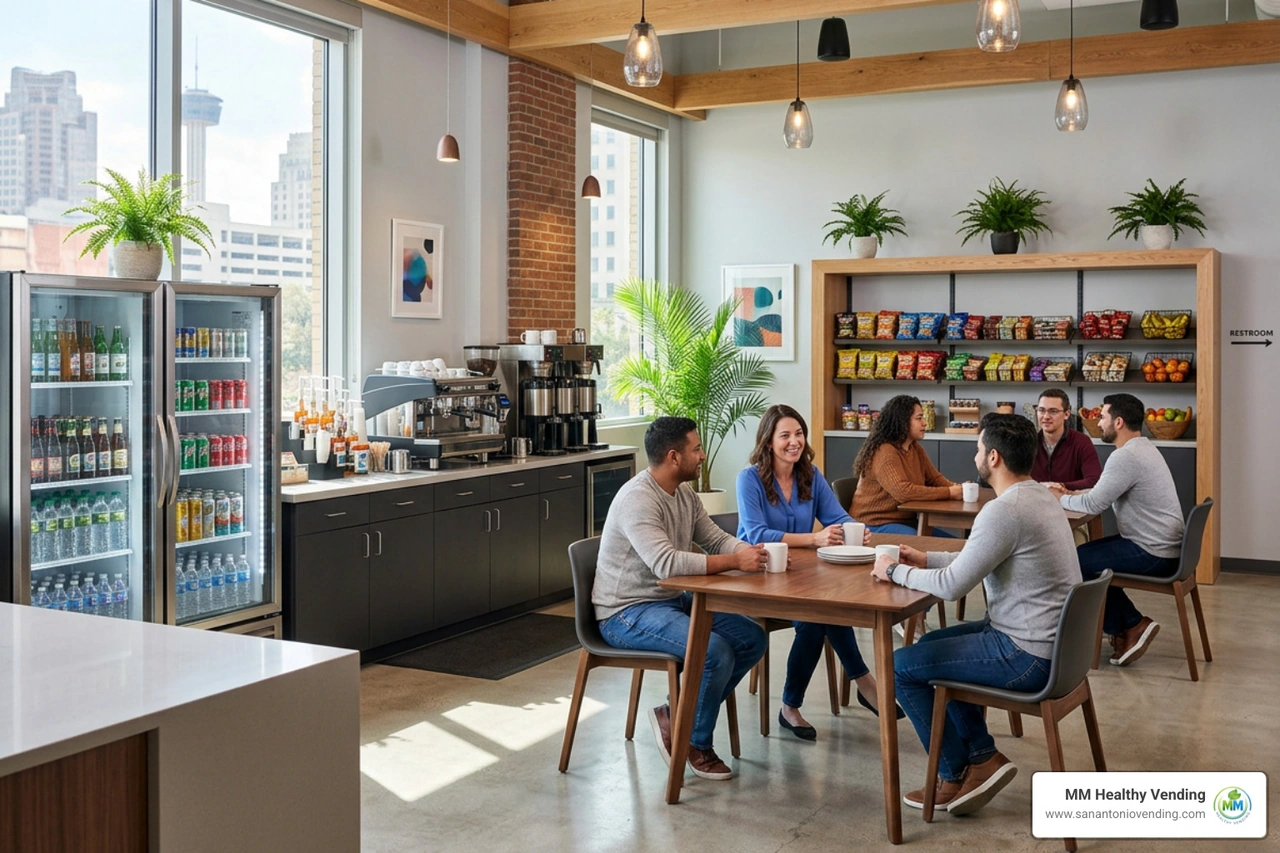
Employees need food, caffeine, and breaks to maintain their energy throughout the day. If the office lacks basic amenities, people will leave the building for extended periods to find them. Upgrading the breakroom with smart solutions keeps people on-site, saves them time, and simplifies inventory management.
Cashless Micro-Markets and Smart Fridges
Traditional vending machines are prone to jamming, require exact change, and offer a limited selection of heavily processed items. The modern alternative is the cashless micro-market or smart fridge.
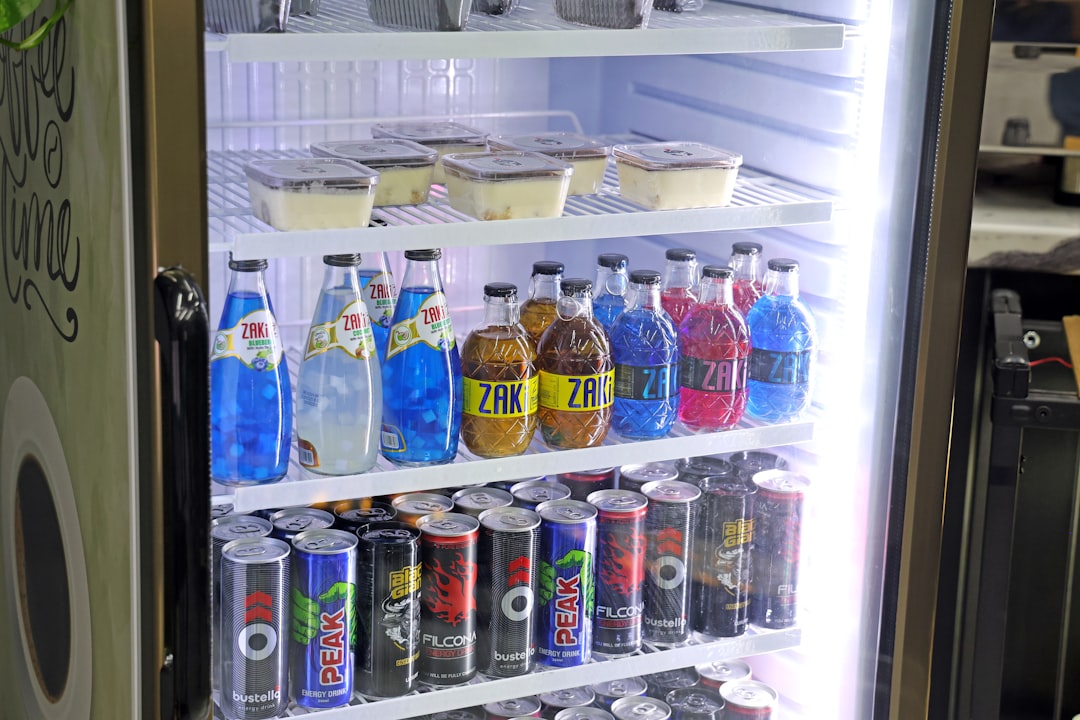
A micro-market consists of open shelving and glass-front coolers stocked with fresh lunches, healthy snacks, and beverages. Employees simply pick up what they want and scan the items at a self-checkout kiosk using a credit card or a reloadable employee account. Smart fridges work similarly; an employee swipes their card to unlock the door, and RFID tags or weight sensors automatically detect which items they removed, billing them accordingly when the door shuts.
Connected Coffee Machines and Water Dispensers
Coffee is a critical office resource. Breakdowns cause immediate frustration and a flood of IT or facilities tickets. Connected, bean-to-cup coffee machines eliminate many of the maintenance headaches associated with standard drip brewers.
These smart machines connect to the office Wi-Fi and send telemetry data back to the facilities manager or the vending supplier. If the machine is running low on beans, needs to be descaled, or detects a mechanical fault, it automatically generates an alert. This predictive maintenance ensures the machine is serviced before it actually breaks down, meaning employees rarely encounter an out-of-order sign.
Optimizing Physical Security and Access
Physical keys and traditional RFID access badges are both a security vulnerability and an administrative burden. People forget their badges at home, lose them on the train, or lend them to coworkers. Modernizing your access control systems streamlines building entry and tightens security.
Mobile Access Control
Mobile access control transforms an employee's smartphone into their building key. Using Bluetooth or Near Field Communication (NFC), employees just hold their phone near the door reader to gain entry.
From an efficiency standpoint, this is highly practical for the administrative team. HR or IT can issue a mobile credential to a new hire over the air on their first day. If an employee quits or is terminated, their access can be revoked instantly through a cloud-based dashboard. There is no longer a need to print plastic badges, track down physical keys, or worry about former employees retaining access to the building.
Smart Lockers for Personal Storage
As more companies move to hybrid work models and hot-desking, employees no longer have permanent filing cabinets or desk drawers to store their personal belongings. This creates clutter and frustration as people carry heavy bags around the office all day.
Smart day lockers provide a secure, temporary storage solution. An employee walks up to a bank of lockers, finds an available one, and uses their smartphone or employee badge to claim it. The locker is securely assigned to them for the day. At the end of their shift, they take their belongings, and the locker resets for the next person. Administrators can also set rules so that lockers automatically open at midnight to prevent people from hoarding spaces.
Enhancing IT and Equipment Management
Handling minor IT requests is a massive drain on technical support teams. When an employee forgets their laptop charger or needs a new mouse, they shouldn't have to submit a helpdesk ticket and wait three hours for a response. Decentralizing and automating hardware access keeps workers productive.
Self-Service IT Vending Kiosks
Smart vending machines are not just for snacks. Many IT departments use modified vending machines to dispense computer peripherals like keyboards, headsets, charging cables, and adapters.
If an employee's mouse breaks, they walk up to the machine, swipe their badge, and select a new one. The machine dispenses the item and automatically records the transaction. This data syncs back to the IT inventory management system. IT can easily track which departments are consuming the most hardware and automate chargebacks to specific department budgets, all without a technician ever talking to the employee.
Smart Print Stations with Cloud Release
Shared office printers frequently cause bottlenecks. Employees send a document to print, walk to the machine, and find a paper jam. They then have to go back to their desk, select a different printer, and try again. Furthermore, printing sensitive documents directly to a tray risks exposing confidential data to anyone walking by.
Cloud printing with secure badge release solves both problems. An employee sends their document to a universal, cloud-based print queue rather than a specific machine. They can then walk up to any printer in the building, swipe their mobile credential or ID badge, and the machine prints their document on the spot. If one printer is jammed, they simply walk to the next one. This prevents wasted paper, secures sensitive information, and drastically reduces helpdesk tickets regarding offline printers.
Tracking Usage Data to Improve Workflows
The hidden advantage of installing smart convenience solutions is the data these systems generate. Every time a door unlocks, a meeting room is booked, or a locker is used, it creates a data point. When analyzed practically, this data allows office managers to stop guessing and start making decisions based on actual behavior.
Leveraging Occupancy Sensors
Understanding how your office is actually used prevents you from making expensive real estate mistakes. Occupancy sensors placed under desks and in common areas provide an anonymous, real-time map of office density.
You might assume your office needs more large conference rooms because people complain about them always being booked. However, your occupancy data might reveal that 80 percent of the time, those large rooms are only being used by one or two people taking a video call. This data tells you that you don't need to build another conference room; instead, you need to install several single-person acoustic phone booths.
Feedback Loops for Continuous Improvement
Smart systems often come with built-in feedback mechanisms. For example, a small tablet placed near the restrooms or in the main breakroom can display three simple buttons: a green smiley face, a yellow neutral face, and a red sad face.
If an employee notices the paper towels are out, they tap the red button. This instantly sends an alert to the janitorial staff or facilities team to service that specific area. This shifts maintenance from a rigid, time-based schedule—cleaning the restroom every two hours whether it needs it or not—to a demand-based schedule. The facilities team works more efficiently, and employees enjoy a cleaner, more responsive workplace.
Implementing these smart convenience solutions requires an initial investment of time and capital. However, by chipping away at the small daily frustrations of office life—from finding a meeting room to dealing with a jammed printer—you build an environment where employees can genuinely focus on their core responsibilities.
You might also like...
More articles like the one you've read to keep you up-to-date on all things vending in San Antonio

Why San Antonio businesses choose us
Premium service, local expertise, cutting-edge technology
AI-powered smart coolers
Advanced computer vision technology for seamless, cashless transactions. Just grab what you need and go.
cashless
24/7 service
Round-the-clock support with an average 2-hour response time for any issues.
Local & trusted
Family-owned business proudly serving San Antonio since 2024
Ready to upgrade your breakroom?
Join hundreds of San Antonio businesses enjoying free, premium vending soutions